
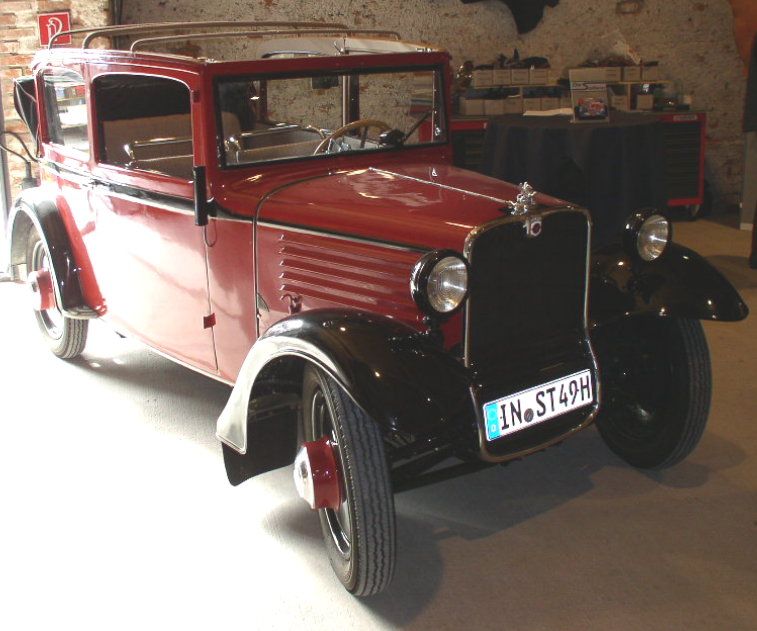
Stoewer V5 History
One of Germany's first mass-produced front-wheel-drive cars — a 1.2-litre compact with 2,100 units built across two years.
Photo: “MHV Stoewer V5 1932 01.jpg” by MartinHansV / Wikimedia Commons — Public domain
History
Launched in 1931, the Stoewer V5 was one of Germany's first mass-produced front-wheel-drive automobiles — alongside the DKW F1 — and a significant engineering step for the Stettin firm. It used a 1.2-litre four-cylinder engine producing 25 PS, with all-around independent suspension and swing axles; the sportier V5S variant raised output to 30 PS and top speed to 100 km/h.
Production reached 1,380 cars in 1931 and 720 in 1932. The car was offered as a sedan, convertible, and roadster. Despite its technical merit, the Nazi-controlled supervisory board deemed the light front-drive layout unsuitable for military requisition and demanded its cancellation — a decision that also led to the Stoewer brothers being forced out of their own company by 1934.
Generations
First and only generation · V5
Photo: “MHV Stoewer V5 1932 01.jpg” by MartinHansV / Wikimedia Commons — Public domain
1.2-litre front-wheel-drive compact with all-round independent swing-axle suspension; 2,100 built across sedan, convertible, and roadster bodies.
1932 Photo: “MHV Stoewer V5 1932 01.jpg” by MartinHansV / Wikimedia Commons — Public domain
Body styles
- Sedan
- Convertible
- Roadster
Notable special editions & performance variants
V5S
Sportier variant with a 30 PS engine upgrade over the standard 25 PS, raising top speed from 80 km/h to approximately 100 km/h.
Related models
Collect the nameplate
Find a scale model of the Stoewer V5
Search Amazon across available years, colors, and scales. Exact releases vary, so confirm the listing before ordering.