
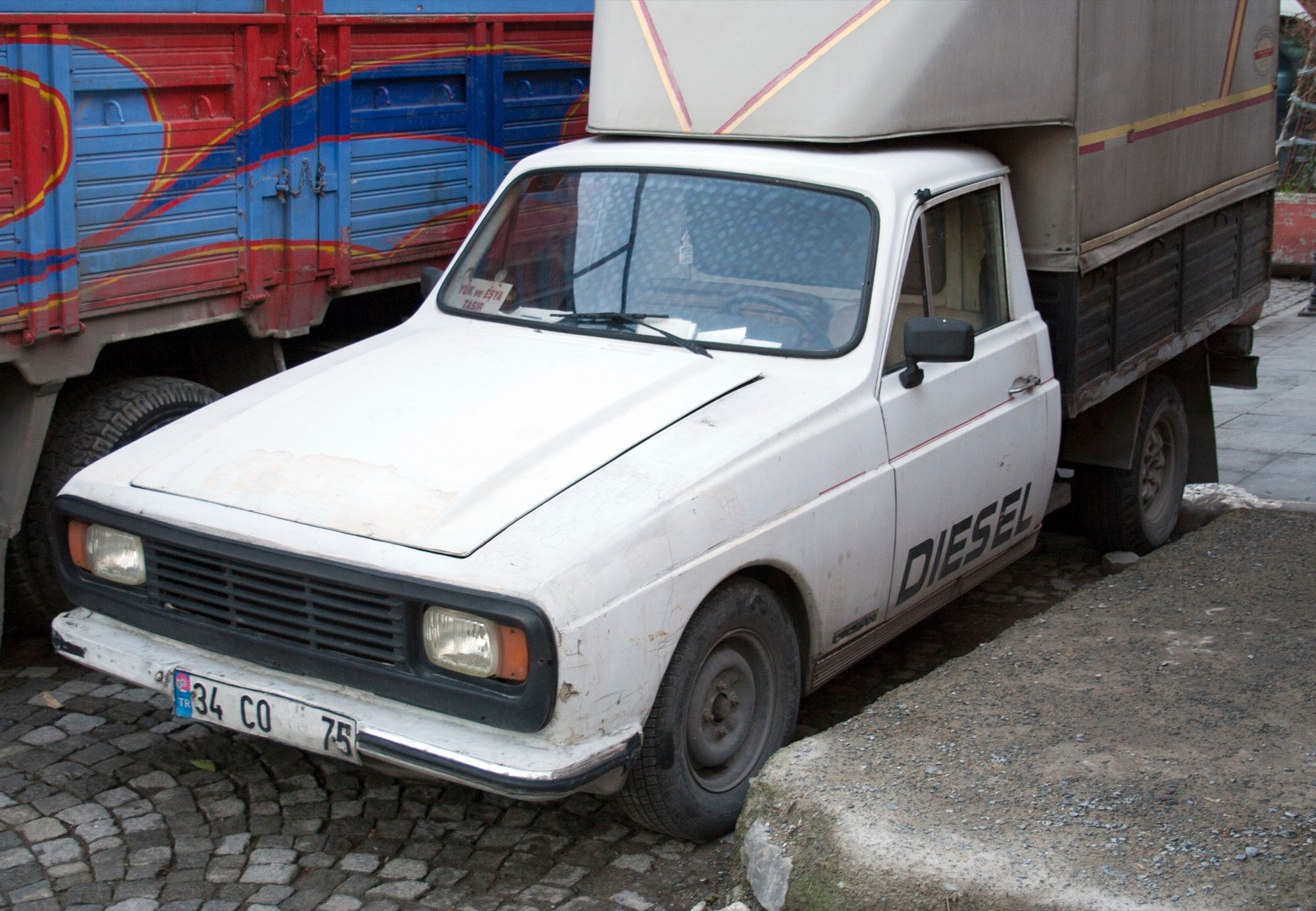
Otosan P2 500 History
The longest-running Otosan product — a light pickup that outlasted all Anadol passenger cars and served as the backbone of Turkish postal and utility fleets for two decades.
Photo: “Otosan P2 600D white.jpg” by Mr.choppers / Wikimedia Commons, licensed under CC BY-SA 3.0
History
Serial production of the P2 500 pickup began in 1971, initially equipped with the 1.3-litre Ford Crossflow engine. Where the passenger-car Anadols targeted private buyers and taxis, the P2 500 addressed a more durable demand: light commercial work, municipal fleets, and the Turkish Post (PTT), which adopted it as a standard vehicle.
Over its twenty-year life the powertrain was upgraded twice: the 1980s brought a 1.6-litre Ford Pinto engine, and a 1.9-litre diesel version (the P2 600D) was added for buyers who prioritised fuel economy. These updates kept the platform competitive long after the passenger-car Anadols had been retired.
Production continued until 1991 — four years after the final Anadol passenger car — and total output reached 36,892 units, making it the highest-production single model in the Otosan/Anadol catalogue. The P2 500's commercial durability stands as a counterpoint to the creative ambition of the STC-16: modest in concept, it proved the most enduring thing Otosan ever made.
Generations
First (and only) generation · Otosan P2 500
Photo: “Otosan P2 600D white.jpg” by Mr.choppers / Wikimedia Commons, licensed under CC BY-SA 3.0
Light pickup launched with the 1.3-litre Ford Crossflow engine; powertrain upgraded to a 1.6-litre Ford Pinto in the 1980s and a 1.9-litre diesel P2 600D added. Backbone of municipal and Turkish Post (PTT) fleets; 36,892 built.
Body styles
- Pickup truck
Related models
Collect the nameplate
Find a scale model of the Otosan P2 500
Search Amazon across available years, colors, and scales. Exact releases vary, so confirm the listing before ordering.