
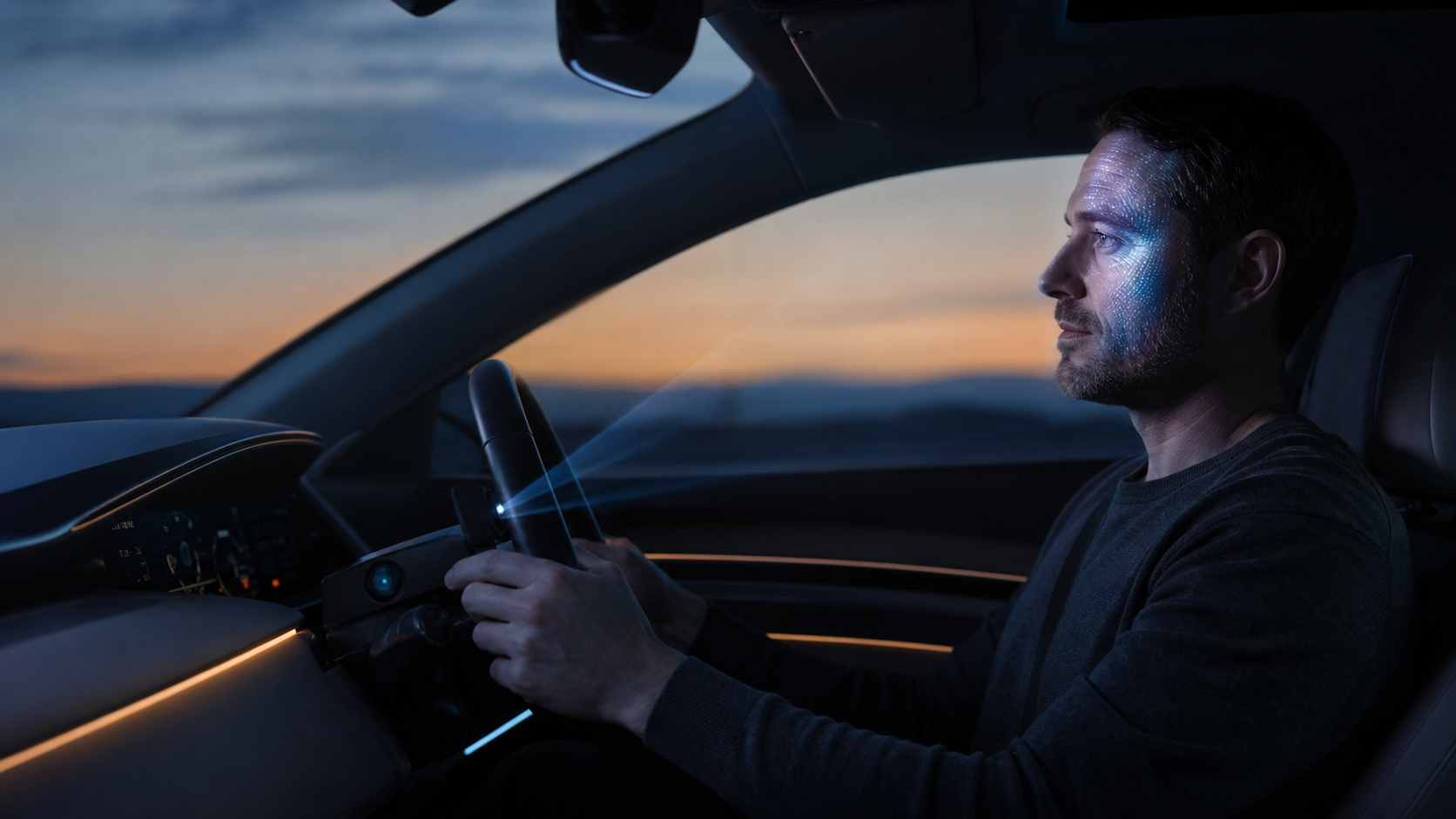
Driver-monitoring camera mandate: will new cars watch the driver?
Congress ordered a safety rule, but that is not the same as a final nationwide mandate for driver-facing cameras. Here is what is actually on the books.
Answer first
No final federal rule currently says every new passenger car must carry a driver-facing camera next year.
What Congress required
Section 24220 of the 2021 Infrastructure Investment and Jobs Act directed the U.S. Department of Transportation to create a safety standard for advanced drunk- and impaired-driving prevention technology. The statute describes systems that can passively monitor driver performance, detect an unlawful blood-alcohol concentration, or combine those approaches.
The law set a rulemaking assignment and timing framework. It did not itself select a camera, require continuous video recording, or make a particular sensor package mandatory in every vehicle.
Why cameras keep entering the conversation
Driver-monitoring cameras are one available way to estimate gaze, eyelid closure, head position, and attention. Other approaches include steering behavior, vehicle motion, breath sensing, and touch-based alcohol detection. A future rule could permit one technology, several alternatives, or a performance target that manufacturers meet in different ways.
NHTSA's February 2026 report to Congress still describes research and rulemaking work. That status matters: a proposal, statutory deadline, agency report, and final Federal Motor Vehicle Safety Standard are four different things.
What drivers should watch for next
The decisive document will be a final rule published by NHTSA and the Federal Register. It should specify covered vehicles, required performance, phase-in dates, testing, privacy-related design constraints if any, and the effective model years.
- Treat claims about a universal camera requirement or a fixed model year cautiously unless they cite a final rule.
- A vehicle may already use a camera for its own hands-free or attention-assistance feature even without a federal mandate.
- Camera presence does not by itself prove that video leaves the vehicle; the owner's privacy notice and data controls govern that question.
Separate attention monitoring from impairment prevention
A driver-facing camera used by a manufacturer assistance package may estimate gaze, head pose, or eyelid behavior so the system can decide whether the driver remains engaged. The congressional directive addresses advanced drunk- and impaired-driving prevention and permits more than one performance approach. Those purposes can overlap, but they are not legally or technically identical.
When evaluating a claim, ask which vehicle function is being discussed, whether the source is a statute, agency research, proposal, or final rule, and whether the system senses attention, driving performance, alcohol, or several inputs. Do not turn one manufacturer's design choice into a nationwide equipment requirement.
What the exact vehicle can reveal today
The owner's manual and privacy notice should identify the installed driver-monitoring feature, its warnings, operating limits, camera location, settings, and stated data practices. A camera housing does not establish whether images are retained, transmitted, or used only for local real-time analysis.
Before purchase, compare the exact model year and assistance package, test the takeover warnings, and ask what happens when the camera is blocked. For privacy decisions, follow the manufacturer's current notice and account controls; for a mandate claim, follow NHTSA and the Federal Register.
Evidence ledger
Primary sources
Historical and technical claims were checked against the sources below on August 13, 2026. The linked source controls.