
Are cars listening to us or recording us?
Modern cars can collect location, driving, phone, voice, camera, and biometric data. What they actually retain or transmit depends on the vehicle and enabled services.
Answer first
Some cars can capture audio commands, cabin imagery, precise location, and driving behavior—but you should not assume every microphone continuously records or uploads conversations.
What a connected car can know
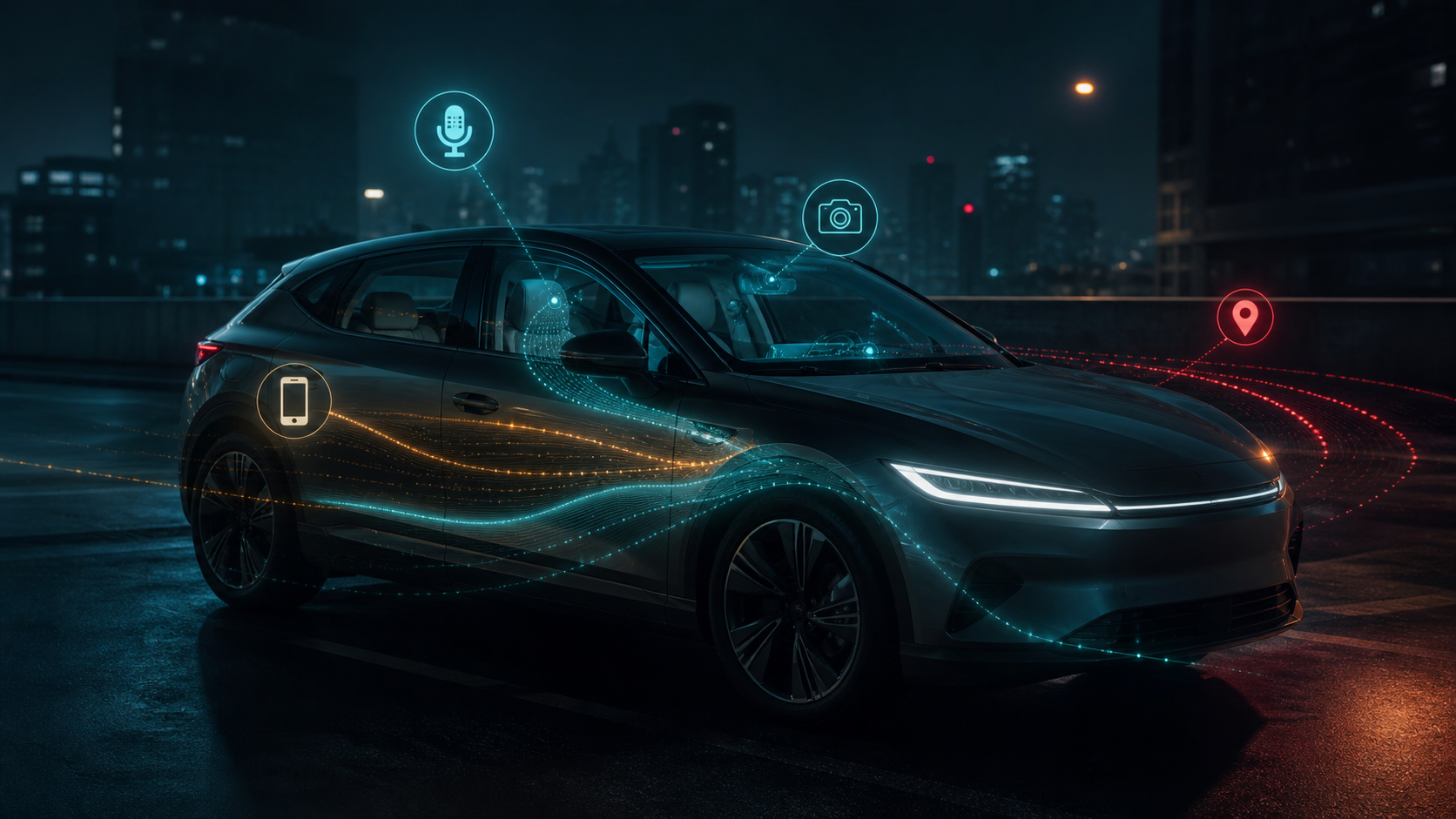
Connected car privacy and car data privacy start with an inventory: a current vehicle can combine telematics, navigation, mobile-app, infotainment, driver-assistance, and paired-phone data. Depending on the model and settings, that may include precise location, speed, braking, seat-belt status, diagnostic data, contacts, messages, voice commands, camera-derived attention signals, and identifiers tied to a driver or account.
The questions ‘do cars record conversations?’ and ‘what data does my car collect?’ require separating sensing, processing, storing, and transmitting. A microphone may listen locally for a wake word without sending a continuous cabin recording. Vehicle telematics privacy also depends on whether location and driving data stay in the car or reach a manufacturer, insurer, app, or service provider.
Why this is not a hypothetical privacy issue
In January 2026, the Federal Trade Commission finalized an order resolving allegations that General Motors and OnStar collected and sold precise geolocation and driving-behavior data without adequately informing consumers and obtaining affirmative consent. The order includes consent, access, deletion, disablement, and opt-out requirements, with limited exceptions.
That enforcement action concerned location and driving behavior—not an allegation that GM secretly recorded every cabin conversation. It nevertheless shows why owners should examine what the car, companion app, and connected-services account are configured to share.
A five-minute privacy check
Controls differ, so use the owner's manual and the manufacturer's current privacy notice for the exact vehicle and service.
- Open the vehicle and companion-app privacy menus; disable optional analytics, personalization, precise location, and driver-scoring features you do not want.
- Review microphone, camera, voice-assistant, dashcam, valet, teen-driver, and insurance-program settings separately.
- Delete paired phones, contacts, destinations, garage codes, digital keys, and user profiles before selling, returning, or renting a vehicle.
- Ask the manufacturer how to download and delete account-linked vehicle data—and what safety or emergency functions cannot be disabled.
- Do not infer that turning off one app setting disables every independent data stream.
Do cars record conversations? Trace each data path
A microphone can support hands-free calling, a wake word, voice commands, emergency calling, or active noise control. A cabin camera can support driver attention, occupant sensing, video calling, security, or a user-enabled recorder. Telematics can transmit location and vehicle events without using either cabin sensor.
Inventory each function separately and look for the stated processing location, retention period, recipient, and control. Avoid both extremes: the presence of a sensor does not prove continuous cloud recording, while the absence of a visible recording icon does not prove that no account or driving data leaves the car.
How to verify a particular car
Start with the VIN-linked equipment list, owner's manual, infotainment privacy menu, companion app, and current manufacturer privacy notice. Review optional insurance, fleet, charging, roadside, dashcam, voice-assistant, and phone-projection services because they can create independent records and recipients.
Request access or deletion where offered, note the response scope, and retest remote access after a sale or account transfer. If the documentation does not disclose whether raw audio or imagery is stored, state that uncertainty rather than converting a general data category into a claim about continuous recording.
Evidence ledger
Primary sources
Historical and technical claims were checked against the sources below on August 13, 2026. The linked source controls.
- Federal Trade CommissionFTC final order involving GM and OnStar connected-vehicle data
- Federal Trade CommissionCars & Consumer Data: On Unlawful Collection & Use