
Magna Steyr Pinzgauer History
Catalog record
Photography for this nameplate has not yet cleared the archive’s licensing and identity checks. The researched text below remains available while the page stays out of search and advertising inventory.
History
The Pinzgauer — again named after an Austrian mountain breed, this time a horse — was developed from 1969 as a larger successor to the Haflinger, and production began in 1971. The first generation comprised the 710 (4×4) and 712 (6×6) models, powered by an air-cooled petrol four-cylinder mounted centrally under the floor; the central-tube backbone chassis with portal axles gave impressive ground clearance. Approximately 18,000 first-generation vehicles were built through 1985.
A second generation (716/718) launched in 1986 with a water-cooled engine option and modernised cab, and production continued in Graz under Magna's ownership until 2000, when Magna sold the Pinzgauer rights to UK-based Automotive Technik Ltd. The Pinzgauer served armed forces across Europe, Africa, and the Middle East; British forces used the type extensively in the Falklands and Gulf campaigns. UK production continued under BAE Systems until 2007.
Generations
First generation (710/712) · Air-cooled original
4×4 (710) and 6×6 (712) with air-cooled engine; ~18,000 built in Graz.
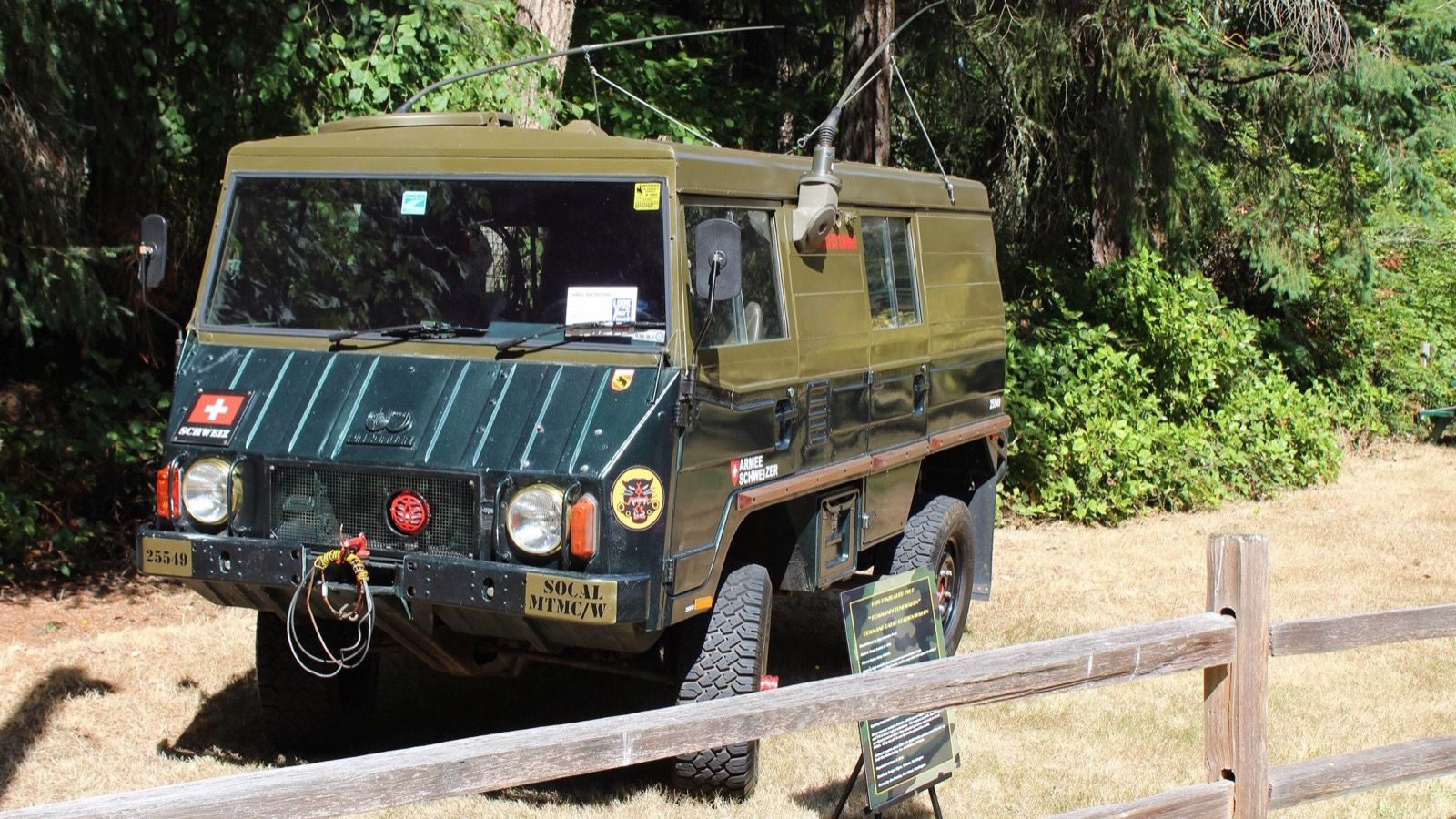
1976 Photo: “1976 Pinzgauer 710K ex Swiss Army Fox Island Car Show 2016 02.jpg” by Thorsten Lindner / Wikimedia Commons, licensed under CC BY-SA 4.0. Cropped to 16:9.
Second generation (716/718) · Water-cooled series
Updated 4×4 (716) and 6×6 (718) with water-cooled engine option; Graz production ended 2000 when rights were sold.
Body styles
- Hardtop
- Soft-top
- Truck
Related models
Collect the nameplate
Find a scale model of the Magna Steyr Pinzgauer
Search Amazon across available years, colors, and scales. Exact releases vary, so confirm the listing before ordering.