
Fifth generation · S197 · 2005–2014
2010Ford Mustang
The S197, whose retro styling revived 1960s-fastback cues, produced 2005–2014.
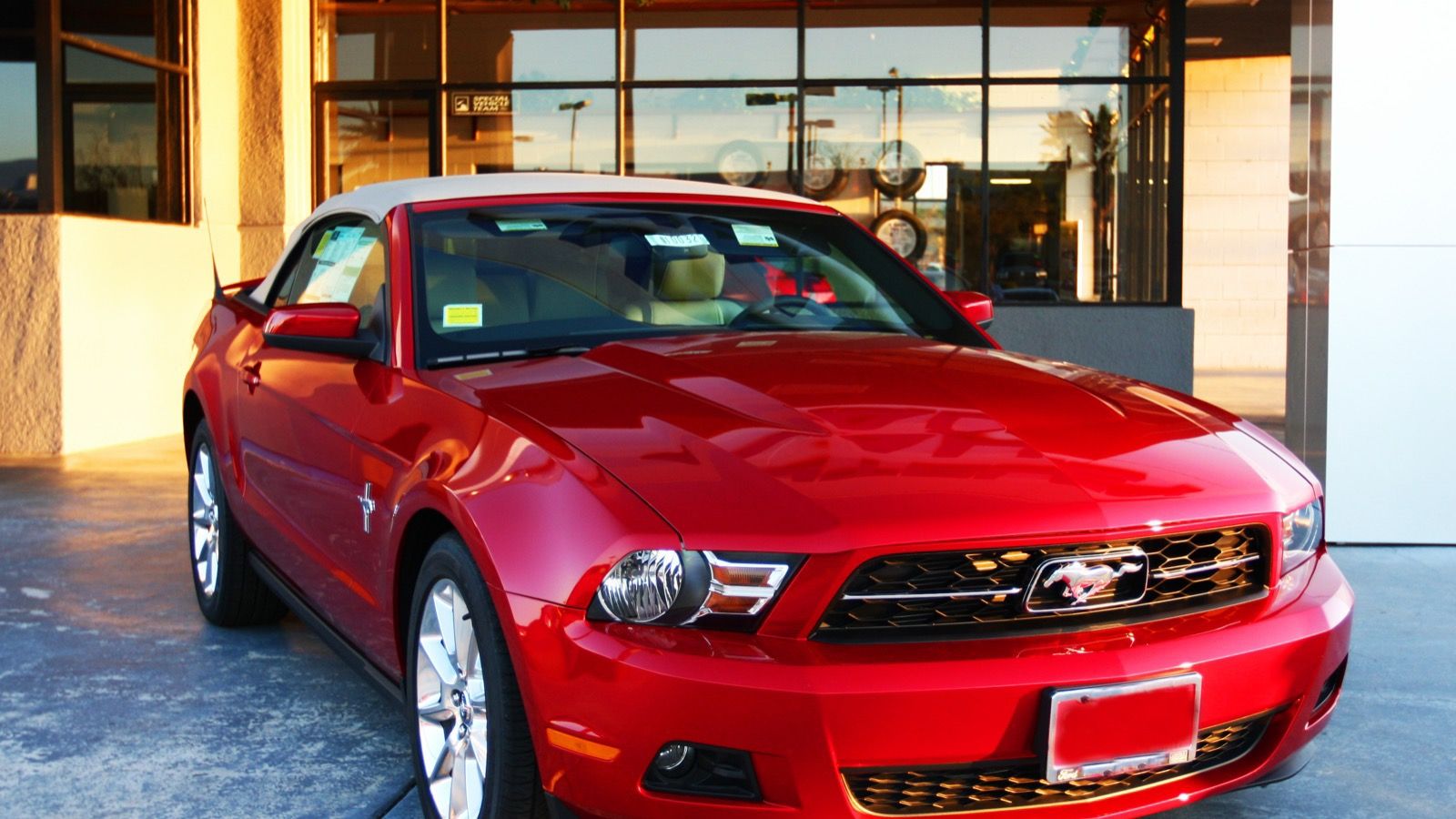
Photo: “2010 Mustang Convertible (3978957062).jpg” by Rennett Stowe from USA / Wikimedia Commons, licensed under CC BY 2.0. Cropped to 16:9.
Quick facts
- Engines
- 3offered4.0 Cologne V6 → 5.4 supercharged DOHC V8 (Shelby GT500)
- Top output
- 540hp5.4 supercharged DOHC V8 (Shelby GT500)
- Production
- 73,716unitsU.S. build
- Base price
- $21,395V6 coupe
- Today
- ≈$30,800inflation-adjusted MSRP, not market value
Body stylesCoupe · Convertible
Start here
What do you need to know?
This page covers the whole 2010 Ford Mustang model year. Choose your task first; exact trims and engines are separated where the factory offered different versions.
Documented lineup
Find your exact 2010 Mustang
Start with a family, body style, or engine. Every card opens the facts and maintenance information for that factory version.
Exact factory pairings documentedHow this lineup was verified
These source-backed records identify published body, engine, and transmission combinations. Exact pairings do not by themselves assert that every factory option or special edition is represented.
V6 Coupe Manual
- Body
- Coupe
- Engine
- 4.0L SOHC V6
- Gearbox
- 5-speed manual
- Built
- Regular production
V6 Coupe Automatic
- Body
- Coupe
- Engine
- 4.0L SOHC V6
- Gearbox
- 5-speed automatic
- Built
- Regular production
V6 Convertible Manual
- Body
- Convertible
- Engine
- 4.0L SOHC V6
- Gearbox
- 5-speed manual
- Built
- Regular production
V6 Convertible Automatic
- Body
- Convertible
- Engine
- 4.0L SOHC V6
- Gearbox
- 5-speed automatic
- Built
- Regular production
V6 Premium Coupe Manual
- Body
- Coupe
- Engine
- 4.0L SOHC V6
- Gearbox
- 5-speed manual
- Built
- Regular production
V6 Premium Coupe Automatic
- Body
- Coupe
- Engine
- 4.0L SOHC V6
- Gearbox
- 5-speed automatic
- Built
- Regular production
V6 Premium Convertible Manual
- Body
- Convertible
- Engine
- 4.0L SOHC V6
- Gearbox
- 5-speed manual
- Built
- Regular production
V6 Premium Convertible Automatic
- Body
- Convertible
- Engine
- 4.0L SOHC V6
- Gearbox
- 5-speed automatic
- Built
- Regular production
GT Coupe Manual
- Body
- Coupe
- Engine
- 4.6L 3-valve V8
- Gearbox
- 5-speed manual
- Built
- Regular production
GT Coupe Automatic
- Body
- Coupe
- Engine
- 4.6L 3-valve V8
- Gearbox
- 5-speed automatic
- Built
- Regular production
GT Convertible Manual
- Body
- Convertible
- Engine
- 4.6L 3-valve V8
- Gearbox
- 5-speed manual
- Built
- Regular production
GT Convertible Automatic
- Body
- Convertible
- Engine
- 4.6L 3-valve V8
- Gearbox
- 5-speed automatic
- Built
- Regular production
GT Premium Coupe Manual
- Body
- Coupe
- Engine
- 4.6L 3-valve V8
- Gearbox
- 5-speed manual
- Built
- Regular production
GT Premium Coupe Automatic
- Body
- Coupe
- Engine
- 4.6L 3-valve V8
- Gearbox
- 5-speed automatic
- Built
- Regular production
GT Premium Convertible Manual
- Body
- Convertible
- Engine
- 4.6L 3-valve V8
- Gearbox
- 5-speed manual
- Built
- Regular production
GT Premium Convertible Automatic
- Body
- Convertible
- Engine
- 4.6L 3-valve V8
- Gearbox
- 5-speed automatic
- Built
- Regular production
Shelby GT500 Coupe 6MT
- Body
- Coupe
- Engine
- 5.4L supercharged DOHC V8
- Gearbox
- TREMEC 6-speed manual
- Built
- Regular production
Shelby GT500 Convertible 6MT
- Body
- Convertible
- Engine
- 5.4L supercharged DOHC V8
- Gearbox
- TREMEC 6-speed manual
- Built
- Regular production
No factory configuration matches those filters.
The 2010 model year
Overview
The mid-cycle facelift ("S197 II") sharpened the styling — new powerdome hood, restyled headlamps with integrated turn signals, three-lens sequential LED taillamps, and a more chiseled body. The GT's 4.6 3-valve V8 climbed to 315 hp, and the GT500 jumped to 540 hp. The base 4.0 V6 (210 hp) carried over for one last year before being replaced.
Specifications
- Engines
- 4.0 Cologne V6210 hp
- 4.6 3-valve SOHC V8 (GT)315 hp
- 5.4 supercharged DOHC V8 (Shelby GT500)540 hp
- Transmissions
- 5-speed manual (V6 / GT), 5-speed automatic, Tremec TR6060 6-speed manual (GT500)
- Body styles
- Coupe, Convertible
- Dimensions
- Wheelbase 107.1 in · Length 188.1 in · Width 73.9 in · Height 55.6 in (coupe)
- Base price
- $21,395 (V6 coupe)See what that's worth today →
- Production
- 73,716 (U.S. build)
Year over year
What changed
- Mid-cycle facelift: new sheetmetal, powerdome hood, restyled lamps, sequential LED taillights.
- GT 4.6 3-valve V8 raised from 300 hp to 315 hp.
- Shelby GT500 raised from 500 hp to 540 hp.
- Last year for the 4.0 V6 (replaced by the 3.7 in 2011).
- Interior upgraded with better materials and available SYNC.
Worth knowing
Notable
- First facelift of the S197 — a cleaner, more aggressive look.
- GT500 gained track-focused options as the SVT car matured.
Living with it
Reliability & ownership notes
- The 4.6 3-valve V8 keeps its cam-phaser and spark-plug service notes.
- GT500's 5.4 (still iron-block this year) runs hot under boost — cooling upgrades remain common.
What it costs now
Price today
Current market value
We don't publish a market estimate for the 2010 model year yet. A valuation ships here only when it can be sourced and dated — we'd rather show nothing than a number we can't stand behind.
Original MSRP adjusted for inflation (CPI, 2024); not the car's current market/collector value. Source: U.S. Bureau of Labor Statistics, CPI-U (U.S. city average, all items), annual average.
Maintenance & service parts
Keep your 2010 Mustang on the road
Start with the service interval, then match the engine or exact version you own. Order links appear only when a catalog-backed part number is available, and every listing still needs a fitment check.
Service desk
What this car needs & when
Use this as a service-planning checklist for 2010 Ford Mustang. Start with the interval, confirm which engine or configuration you have, then use an exact ordering reference when one is verified.
- Service topics
- 13
- Factory intervals
- 10
- Fitment-scoped
- 13
- Exact references
- 1
Before orderingIdentify your engine, options and build date.Part numbers and sizes can change within one model year. Shopping links appear only for catalog-backed references; still verify the listing against your vehicle before ordering.
Engine oil and filter
Sourced interval available
Normal engine oil and filter
Whichever comes first. Shelby supplement directs oil service to the shared scheduled-maintenance information; use the engine-specific oil specification.
Source: Ford — 2010 Scheduled Maintenance Guide, second printing, USA · p. 5; Cars & CUVs pp. 29–40; Shelby p. 21 · checked
Special-use engine oil and filter
When primarily towing/carrying loads, extensive idling/low-speed commercial use, dusty or off-road operation. Extensive idling also has a 200-engine-hour limit; whichever comes first. Occasional special use does not automatically require the additional schedule.
Source: Ford — 2010 Scheduled Maintenance Guide, second printing, USA · pp. 5, 41–45 · checked
Engine oil filter
Exact reference available
Manufacturer application-catalog fitment only; this does not establish an oil-change interval.
All cataloged Mustang engines
Baldwin B329
Source: Baldwin Filters — Automotive Applications catalog (2017) · PDF page 229 — Ford 2010, Mustang engine rows · checked
Verified ordering references
- Service replacementBaldwin B329
Qty. 1 · Engine oil filter · catalog-listed
Baldwin's manufacturer application table lists this filter for the stated model year and engine. Confirm the VIN and installed engine before ordering.
Catalog: Baldwin Filters — Automotive Applications catalog (2017) · PDF page 229 — Ford 2010, Mustang engine rows · checked
Search this part on Amazon
Scheduled checks and inspections
Sourced interval available
Normal tire rotation and wheel inspection
Rotate tires, inspect wear and measure tread depth; inspect wheels and related components for noise, wear, looseness or drag. Mileage schedule; no separate calendar is printed.
Source: Ford — 2010 Scheduled Maintenance Guide, second printing, USA · pp. 29–40 · checked
Shelby normal wheel inspection
Inspect wheels and related components for abnormal noise, wear, looseness or drag at normal shared-guide visits; the separate Shelby rotation interval remains 5,000 miles.
Source: Ford — 2010 Scheduled Maintenance Guide, second printing, USA · pp. 29–40 · checked
Shelby GT500 tire rotation
Rotate side to side only: larger rear tires must not move front to rear or in a crisscross pattern. Check uneven wear and adjust inflation afterward.
Source: Ford — 2010 Shelby GT500 Supplement · p. 15 · checked
Special-use tire and wheel checks
Towing, extensive idling or dusty operation: rotate, inspect wear/tread and wheel noise, wear, looseness or drag every 5,000 miles. Off-road operation additionally uses a six-month limit. Shelby rotation remains side to side only.
Source: Ford — 2010 Scheduled Maintenance Guide, second printing, USA · pp. 41–45 · checked
Shelby before-and-after-track inspections
Before and after track use, perform the multi-point inspection and the inspections listed in the 150,000-mile normal schedule. This does not mean performing all 150,000-mile replacements. Consult the supplement for competition preparation and warranty limitations.
Source: Ford — 2010 Shelby GT500 Supplement · p. 32 · checked
Monthly owner checks
Recommended: lights, tire wear/pressure including spare, engine oil and washer-fluid levels.
Source: Ford — 2010 Scheduled Maintenance Guide, second printing, USA · p. 8 · checked
Six-month owner checks
Recommended: seat belts/latches, power-steering and clutch fluid if equipped, washer/wipers, parking brake, hinges/latches/locks, weatherstrips and drain holes, warning lamps, coolant level/strength, battery connections. Excludes unrelated sliding-door and dual-rear-wheel instructions.
Source: Ford — 2010 Scheduled Maintenance Guide, second printing, USA · p. 8 · checked
Recommended inspection at every scheduled visit
Check/top up applicable fluids; inspect tires/spare, exhaust, battery, horn/lights, cooling and air-conditioning hoses, washers/wipers, windshield, leaks, air filter, applicable boots, shocks/struts, steering/linkage, belts and clutch operation. This is Ford’s recommended multi-point inspection, not a new numeric replacement interval.
Source: Ford — 2010 Scheduled Maintenance Guide, second printing, USA · pp. 12–13 · checked
Normal chassis, brake and cooling inspections
Inspect/lubricate steering linkage, ball joints, suspension, tie rods, driveshaft and U-joints (lubricate only grease fittings); inspect cooling system/hoses, brakes/parking brake, applicable half-shaft boots, exhaust/heat shields. Inspect transmission fluid only if an underhood dipstick is fitted.
Source: Ford — 2010 Scheduled Maintenance Guide, second printing, USA · pp. 29–40 · checked
Commercial-idling brake and ball-joint service
Inspect brakes and lubricate control-arm/steering ball joints if fitted with grease fittings. Includes tire/wheel checks; retain Shelby side-to-side-only tire rule.
Source: Ford — 2010 Scheduled Maintenance Guide, second printing, USA · p. 42 · checked
Cabin air filter
Sourced interval available
Cabin-filter replacement and inspection
Replace if equipped every 15,000 miles; inspect at intervening 7,500-mile visits. Inspect frequently and replace as required in extensive-idling, dusty or off-road service.
Source: Ford — 2010 Scheduled Maintenance Guide, second printing, USA · pp. 29–45 · checked
Engine air filter
Sourced interval available
Engine air-filter replacement
Normal replacement every 30,000 miles. Dusty operation: inspect frequently and replace as required. Shelby supplement explicitly directs air-filter intervals to the shared schedule.
Source: Ford — 2010 Scheduled Maintenance Guide, second printing, USA · pp. 31, 33, 35, 37, 40, 44; Shelby p. 25 · checked
Fuel filter
Sourced interval available
Normal fuel-filter replacement
The shared schedule explicitly includes Mustang. No calendar interval is stated. For California-registered vehicles this maintenance is not required for emissions warranty or recall liability; Ford still recommends the interval (p. 47).
Source: Ford — 2010 Scheduled Maintenance Guide, second printing, USA · pp. 31, 33, 35, 37, 40 · checked
Idling or dusty-use fuel filter
For primarily extensive idling/low-speed commercial use or dusty conditions; Mustang is explicitly included. For California-registered vehicles this maintenance is not required for emissions warranty or recall liability; Ford still recommends it (p. 47).
Source: Ford — 2010 Scheduled Maintenance Guide, second printing, USA · pp. 42, 44 · checked
Spark plugs
Sourced interval available
V6 and GT normal spark-plug replacement
First listed normal replacement at 90,000 miles; do not substitute an adjacent-year 100,000-mile interval or infer unprinted recurrence.
Source: Ford — 2010 Scheduled Maintenance Guide, second printing, USA · p. 35 · checked
V6 and GT commercial-idling spark plugs
Every 60,000 miles when primarily extensive idling or low-speed long-distance commercial operation. Shelby retains its shorter dedicated interval.
Source: Ford — 2010 Scheduled Maintenance Guide, second printing, USA · p. 42 · checked
Shelby GT500 spark-plug replacement
Every 45,000 miles (72,000 km), explicitly specified for this high-performance engine.
Source: Ford — 2010 Shelby GT500 Supplement · p. 25 — Engine Spark Plug Interval · checked
Coolant
Sourced interval available
Initial coolant replacement
First change at 105,000 miles or six years, whichever comes first; use the originally specified coolant. Shelby engine coolant uses the original specified coolant; the supplement separately directs coolant-level and concentration checks to scheduled-maintenance information.
Source: Ford — 2010 Scheduled Maintenance Guide, second printing, USA · pp. 5, 36; Shelby p. 21 · checked
Subsequent coolant replacement
After the initial change, every 45,000 miles or three years, whichever comes first.
Source: Ford — 2010 Scheduled Maintenance Guide, second printing, USA · pp. 5, 48 · checked
Drive belts
Fitment must be confirmed
Accessory-belt inspection and replacement
Scheduled inspections at 90,000 and 120,000 miles; at 150,000 replace if not replaced within the last 100,000 miles. Inspect during recommended multi-point visits; no calendar or unsupported recurring replacement is inferred.
Source: Ford — 2010 Scheduled Maintenance Guide, second printing, USA · pp. 12, 35, 37, 40 · checked
Transmission and transfer-case fluid
Sourced interval available
Normal manual-transmission fluid
First listed change at 150,000 miles; manual transmission only.
Source: Ford — 2010 Scheduled Maintenance Guide, second printing, USA · p. 40 · checked
Normal automatic-transmission fluid and filter
First listed fluid and filter replacement. The table’s filter exceptions are 5F55, 6F35 and AWF21, not the Mustang five-speed automatic.
Source: Ford — 2010 Scheduled Maintenance Guide, second printing, USA · p. 40 · checked
Special-use automatic-transmission fluid
Every 30,000 miles when primarily towing, extensive idling, dusty or off-road operation. Table exceptions 6R60/6R80/TorqShift do not apply to the Mustang five-speed automatic.
Source: Ford — 2010 Scheduled Maintenance Guide, second printing, USA · pp. 41–45 · checked
Towing-use manual-transmission fluid
Every 60,000 miles when primarily towing or using a camper/car-top carrier; follow the vehicle’s towing restrictions.
Source: Ford — 2010 Scheduled Maintenance Guide, second printing, USA · p. 41 · checked
Dusty/off-road manual-transmission fluid
Every 50,000 miles when primarily dusty or off-road operation. No calendar interval is stated.
Source: Ford — 2010 Scheduled Maintenance Guide, second printing, USA · pp. 44–45 · checked
Axle fluid
Fitment must be confirmed
Synthetic rear-axle exception
The 4.0L and 4.6L factory rear axles use synthetic lubricant and do not require scheduled replacement unless submerged in water. Investigate suspected leaks or required axle service. Do not apply the generic 150,000-mile rear-axle change.
Source: Ford — 2010 Mustang Owner’s Guide, second printing, USA · pp. 299–300; shared guide p. 47 · checked
Shelby synthetic rear-axle exception
Factory synthetic rear-axle lubricant does not need routine replacement; change after water submersion and investigate leaks or required axle service.
Source: Ford — 2010 Shelby GT500 Supplement · pp. 27–28; shared guide p. 47 · checked
Chassis lubrication
Sourced interval available
Special-use U-joint checks
Towing, extensive idling or dusty use: inspect/lubricate U-joints, whichever comes first. For towing also inspect frequently/service as required. Off-road: frequently inspect/lubricate steering ball joints and U-joints if grease fittings are fitted.
Source: Ford — 2010 Scheduled Maintenance Guide, second printing, USA · pp. 41–45 · checked
Wheel bearing service
Sourced interval available
Conditional special-use front-bearing service
For primarily towing, extensive idling, dusty or off-road operation, replace front-wheel-bearing grease and seals ONLY if nonsealed bearings are used. This conditional shared-guide instruction does not assert that a Mustang has nonsealed bearings.
Source: Ford — 2010 Scheduled Maintenance Guide, second printing, USA · pp. 41–45 · checked
Collect
Bring this model year home
Find a scale model using the exact year, make, and model—not a generic generation search.
Famous variants this year
Sources
Other Fifth generation years
Explore the S197 generation →All Fifth generation · S197 years →