
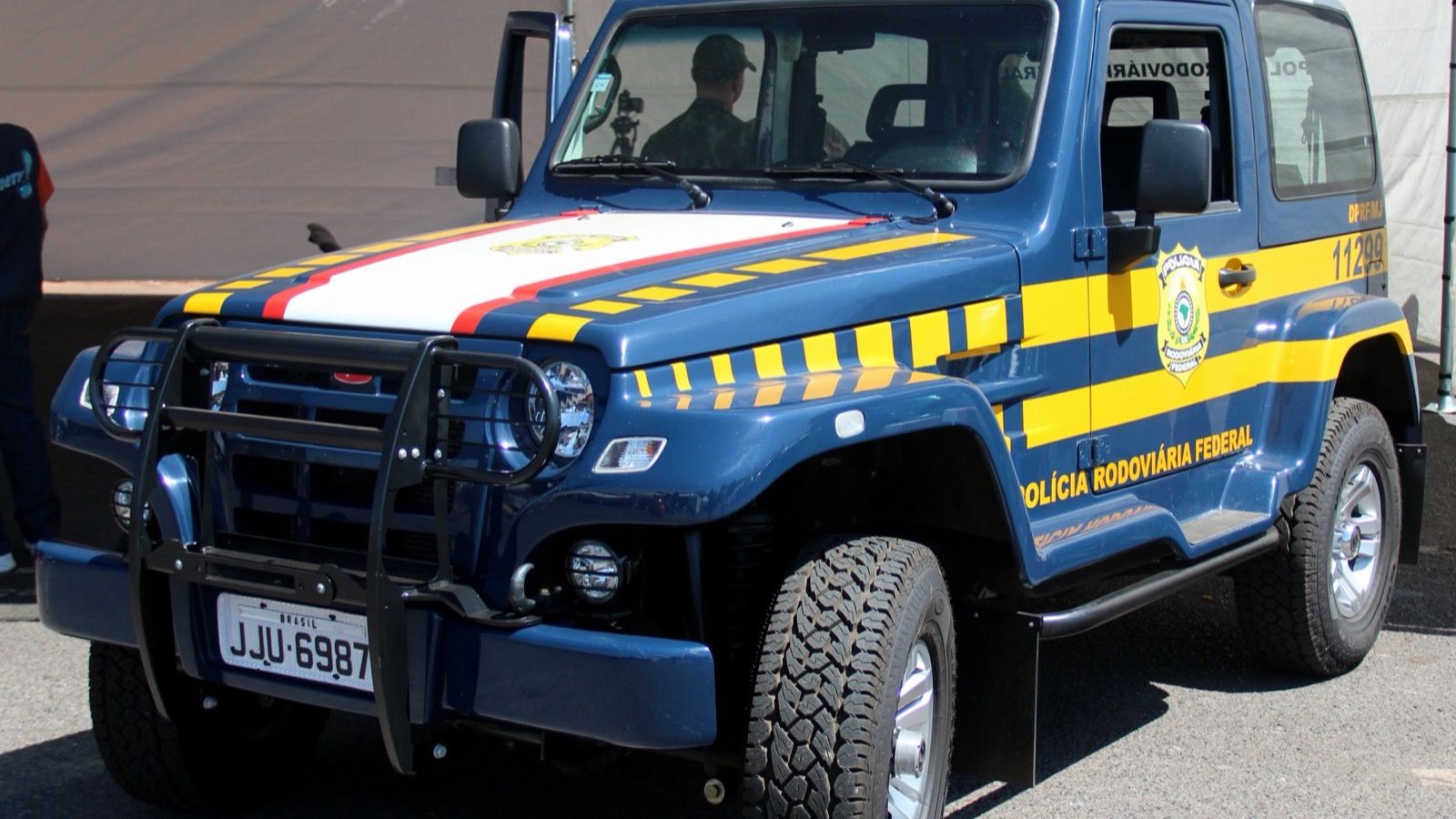
Troller T4 History
Brazil's definitive domestic 4x4 (1996–2021) — a fiberglass-body, body-on-frame off-roader that dominated its niche for over two decades.
Photo: “Troller (7908254726).jpg” by Andre Gustavo Stumpf Filho from Brasil / Wikimedia Commons, licensed under CC BY 2.0. Cropped to 16:9.
History
The T4's origins trace to 1995, when Rogério Farias founded Troller in Horizonte, Ceará. The first prototype was built in April 1996 under the original single-L brand name 'Troler,' and the model was called the RF Sport (RF for Rogério Farias). Built on a tubular steel chassis with a fiberglass composite body — the same construction method used for dune buggies — it measured just 3.94 m long on a 2.40 m wheelbase, with attack and departure angles better than 50 degrees. The early cars used Volkswagen's 1.8-liter AP four-cylinder gasoline engine (99 cv), upgraded to the 2.0-liter AP (110 cv) in 1998; approximately 44 pre-series examples were sold to rally pilots between 1996 and 1997 as a rolling development program.
A new investor, Mário Araripe, acquired the company in 1997 and formalized mass production. The purpose-built Horizonte factory opened in 1999, and by the second generation (2001–2014) the car wore its definitive 'T4' name and moved to diesel engines, gaining wider appeal with Brazilian police, military, and expedition buyers. Ford do Brasil purchased Troller in January 2007 for approximately R$400 million (roughly US$205 million), integrating its supply chain and injecting Ford components into the interior. By mid-2008 the T4 was Brazil's best-selling SUV, and by April 2010 cumulative production had reached 10,000 units.
The third and final generation arrived for 2014, heavily redesigned around Ford's T6 platform — the same underpinning used by the global Ford Ranger — and inspired by Troller's TR-X Concept show vehicle. The new body, now made in SMC (Sheet Molding Compound) fiberglass, sat on a ladder frame with a Bosch ABS, and the sole powertrain was Ford's 3.2-liter five-cylinder Duratorq turbodiesel producing 200 cv (roughly 197 hp) and 470 Nm of torque, driving all four wheels through a Getrag MT-82 six-speed manual; a 6R80 six-speed automatic was added for the 2021 model year. Production ceased in October 2021 when Ford shuttered all of its Brazilian manufacturing operations, ending the T4 after 25 years.
Generations
First generation · RF Sport / original
Tubular chassis, fiberglass body, Volkswagen 1.8/2.0 AP petrol engines; ~44 pre-series rally prototypes (1996–1997), then factory production from 1999.
Second generation · T4 (diesel era)
Photo: “Troller (7908254726).jpg” by Andre Gustavo Stumpf Filho from Brasil / Wikimedia Commons, licensed under CC BY 2.0. Cropped to 16:9.
Carried the T4 name, moved to diesel power, and gained Ford interior components after the 2007 acquisition; reached 10,000 cumulative units by 2010.
Third generation · T4 (Ford T6-platform)
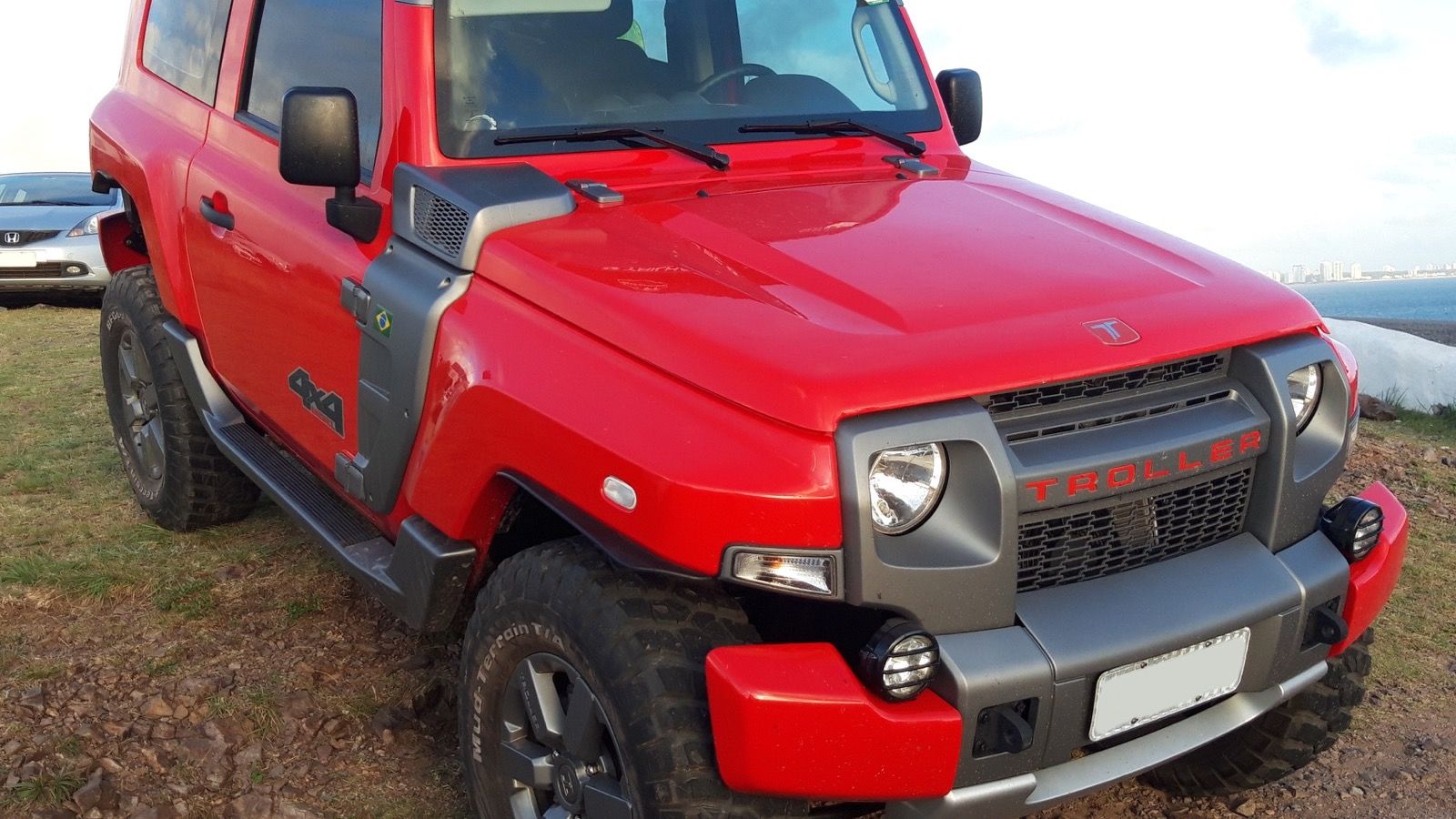
Photo: “Troller T4 Mk2 in Maldonado - front.jpg” by NaBUru38 / Wikimedia Commons, licensed under CC BY-SA 4.0. Cropped to 16:9.
Redesigned on Ford's global Ranger T6 platform with SMC fiberglass body; powered exclusively by the 3.2-liter Duratorq five-cylinder diesel (200 cv); ended with Ford's Brazilian exit.
Body styles
- 2-door hardtop
- 2-door soft-top / open cab
Notable special editions & performance variants
T4 Automático
6R80 six-speed automatic transmission option, offered only in the final 2021 model year alongside the existing six-speed manual.
Related models
Collect the nameplate
Find a scale model of the Troller T4
Search Amazon across available years, colors, and scales. Exact releases vary, so confirm the listing before ordering.