
ARO 24 Series History
Catalog record
Photography for this nameplate has not yet cleared the archive’s licensing and identity checks. The researched text below remains available while the page stays out of search and advertising inventory.
History
After six years of development, ARO launched the 24 Series in 1972 as its ground-up successor to the M461 line. The ARO 240 soft-top cabriolet was the first body style to reach customers, quickly followed by the 241 four-door soft-top, the 242 single-cab pick-up, the 243 three-door hard-top, and the flagship 244 five-door. An extended 246 variant seating seven was added later. Unlike most Eastern-bloc off-road vehicles of the era, the ARO 24 used independent front suspension and a curved ladder chassis, giving it appreciably better on-road manners alongside proven low-range 4x4 capability.
The 24 Series underwent several styling revisions across its 34-year life. The first generation (1972–1976) borrowed Dacia 1300 headlights; from 1977 round headlights replaced them. A new front grille arrived in 1985, Oltcit Club rear lamps were fitted in 1995, and a final 1998 facelift introduced a lighter frontal treatment. Engines evolved from early Romanian 3.2-litre and 2.7-litre non-turbo diesels (68–72 hp) through a 90-hp Peugeot 2.5-litre turbodiesel and later Ford V6 petrol options, reflecting the broader supplier partnerships ARO pursued after 1989.
The 24 Series was manufactured under licence across four countries: in Romania at Câmpulung-Muscel (1969–2006), in Portugal as the Portaro 4x4 (1975–1995), in Spain as the Hisparo 4x4 (1980–1990), and in Brazil as the Cross Lander 244X (2002–2006). Military and emergency-services derivatives included ambulance (323 Sanitară), school-bus (429 TC), and the flat-panelled ARO Dragon built for the Romanian Army. A plan to bring the 244 to the United States was cancelled in 2005; the company entered bankruptcy in June 2006.
Generations
First generation · Dacia-headlight body
Original 24 Series with Dacia 1300 headlights and round taillights; Romanian non-turbo diesel engines; 240 soft-top launched the family.
Second generation · Round-headlight facelift
Round headlights replacing the Dacia units; rear light restyling; Portaro and Hisparo licensed production began during this era.
Third generation · New-grille facelift
Revised front grille and smaller round headlights (1985); Peugeot turbodiesel engines added; Oltcit Club rear lamps fitted from 1995.
Fourth generation · Late facelift
Final styling update introducing Toyota-style hood ornaments; Ford V6 petrol option added; production ended with ARO's bankruptcy in 2006.
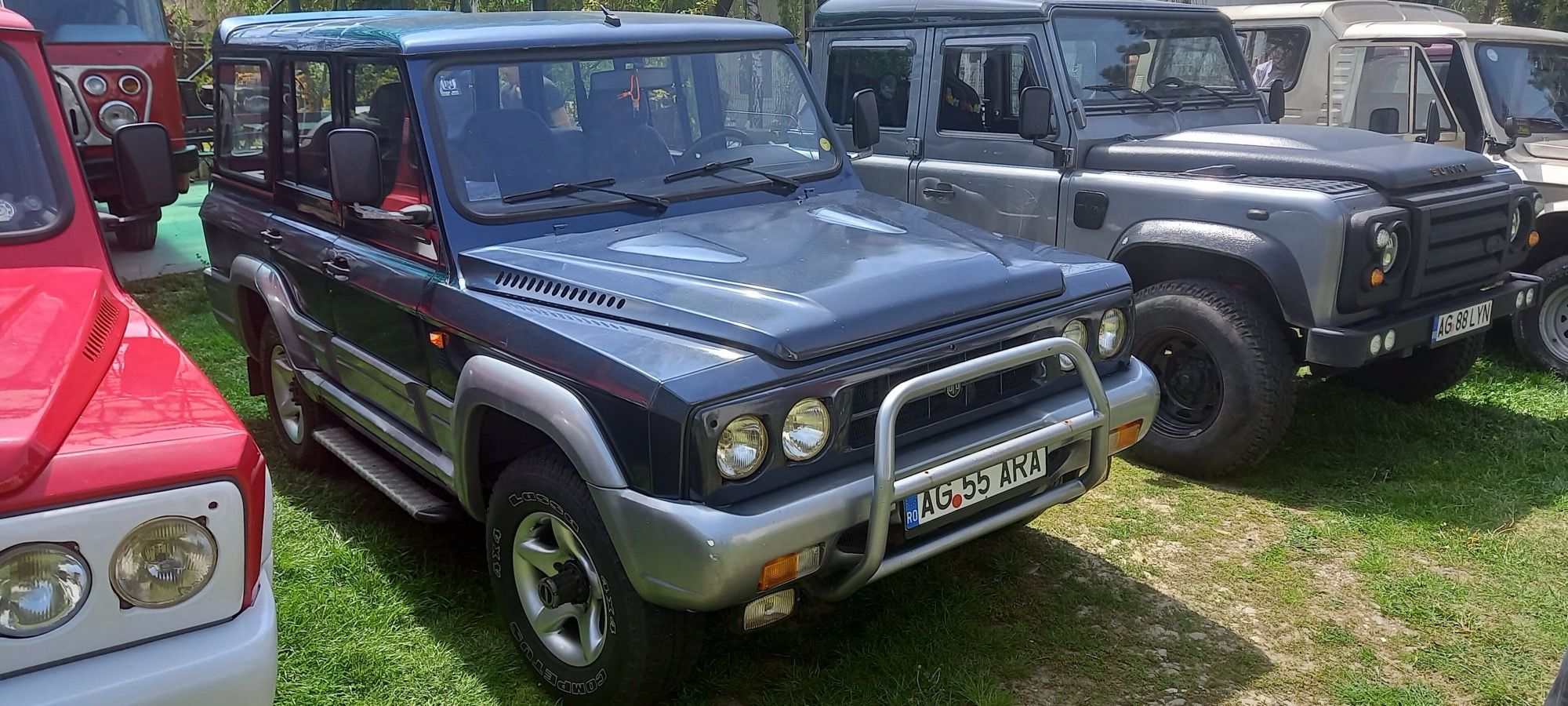
1998 Photo: “ARO 244 (1998 revision)-front view” by ROCostiTheBunnyCZ / Wikimedia Commons — CC0 1.0
Body styles
- 2-door soft-top (240)
- 4-door soft-top (241)
- 3-door hard-top (243)
- 5-door hard-top (244)
- Extended 5-door 7-seat (246)
- Single-cab pick-up (242)
Notable special editions & performance variants
ARO Dragon
Military-specific variant with simplified flat-panel bodywork; produced in armoured and standard configurations for the Romanian Army, with a civilian ARO Dragon Civil derivative also offered.
Cross Lander 244X
Brazilian-market licensed derivative produced in Manaus under the Cross Lander brand; effectively the last production version of the ARO 24.
Related models
Collect the nameplate
Find a scale model of the ARO 24 Series
Search Amazon across available years, colors, and scales. Exact releases vary, so confirm the listing before ordering.