
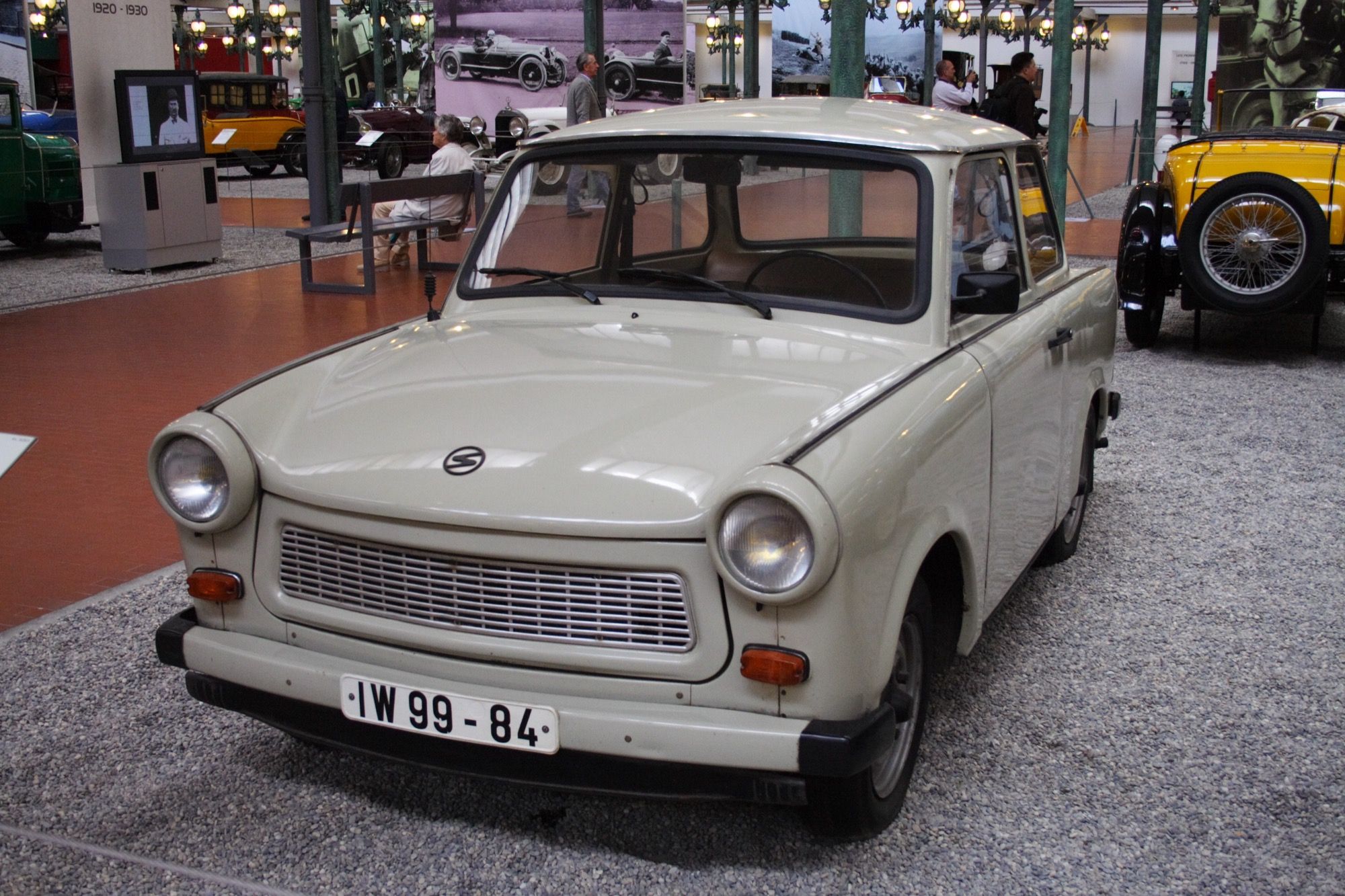
Trabant 601 History
The definitive Trabant — 2,818,547 built over 26 years, the most common car in East Germany and a Cold War icon.
Photo: “Trabant 601 Mulhouse FRA 001.JPG” by ignis / Wikimedia Commons, licensed under CC BY-SA 3.0
History
The Trabant 601 entered pre-production in 1963 with 150 units and reached full series production in 1964, becoming the definitive East German car and one of the most instantly recognizable automobiles of the Cold War era. Over 26 years VEB Sachsenring built 2,818,547 examples — about three quarters of all Trabants ever made — making it the most common vehicle in the GDR.
Its 594 cc air-cooled two-stroke two-cylinder engine, producing a final 26 PS, was technically outmoded well before production ended but was never replaced under the GDR's centrally planned economy, where investment in a replacement was perpetually deferred. The combination of a long waiting list — sometimes a decade or more — and unchanged technology made the 601 simultaneously beloved and mocked. The Duroplast body panels did not rust and proved remarkably durable; the average Trabant lifespan reached 28 years.
The 601 was offered as a two-door saloon and a three-door Universal estate for civilian use, and as the doorless Kübelwagen from 1966 — a semi-military jeep-style body with a folding roof and electromagnetic-interference-shielded ignition — primarily for the East German military and police. A civilian open-body version, the Tramp, was added in 1978 and was mainly exported to Greece. The 601 S and De Luxe trim levels added an aluminium grille, fog lights, a radio, and improved upholstery. The limited Hycomat variant (1965–1990) featured an automatic clutching system for drivers with a missing or non-functional left leg.
When the Berlin Wall fell in November 1989, columns of Trabants became the defining image of German reunification. Within months the Eastern Bloc's former markets collapsed along with the GDR's subsidies, and 601 production ended in 1990 as the Zwickau plant transitioned to Volkswagen ownership — eventually producing VW Golf and Passat engines.
Generations
Original series · P601
The founding 601 production run — saloon and Universal, largely unchanged in body and mechanicals.
Late series (updated interior/trim) · P601 late
Photo: “Trabant 601 Mulhouse FRA 001.JPG” by ignis / Wikimedia Commons, licensed under CC BY-SA 3.0
Incremental interior and equipment updates rather than a single facelift: minor dashboard changes from 1969 and, most significantly, a 12V electrical system with a larger alternator in 1983. The Kübelwagen was added in 1966 and the Tramp in 1978.
Body styles
- 2-door saloon (Limousine)
- 3-door estate (Universal)
- Kübelwagen (doorless military/semi-military)
- Tramp (open civilian off-roader)
Notable special editions & performance variants
601 De Luxe / 601 S
Upmarket trim with aluminium grille, fog lights, radio, and improved upholstery — the top specification for a 601.
Trabant 601 Kübelwagen
Doorless, folding-roof semi-military jeep variant built for the East German military and police; EMI-shielded ignition.
Trabant 601 Hycomat
Low-volume automatic-clutch variant produced for drivers with a non-functional left leg — one of the GDR's few accessibility-focused vehicle adaptations.
Trabant 800 RS
Factory rally-racing variant with a 771 cc engine and 5-speed gearbox, used in East Bloc rallying.
Related models
Collect the nameplate
Find a scale model of the Trabant 601
Search Amazon across available years, colors, and scales. Exact releases vary, so confirm the listing before ordering.