
Hindustan Motors Ambassador History
Catalog record
Photography for this nameplate has not yet cleared the archive’s licensing and identity checks. The researched text below remains available while the page stays out of search and advertising inventory.
History
The Hindustan Ambassador was born when Hindustan Motors entered a licence agreement to manufacture the 1956 Morris Oxford Series III in India, with full tooling transferred to the Uttarpara plant in West Bengal. The first cars rolled out in 1957, initially with the 1,489 cc side-valve BMC B-Series engine; by 1959 a more modern overhead-valve version of the same unit replaced it. Crucially, while Morris moved on, Hindustan kept producing this body essentially unchanged — a decision that turned the Ambassador from a licensed copy into a uniquely Indian institution.
Six distinct marks and sub-variants followed over 57 years. The Mark II arrived in 1963, the Mark III in 1975, and the Mark IV in 1979 — this last one significant for introducing India's first diesel passenger car. The Ambassador Nova (1990) brought a reworked interior and improved brakes; the Classic (named from 1998) gained an Isuzu 1.8-litre petrol engine, and the Grand (2003) incorporated 137 engineering changes. The final Ambassador Encore of 2013–2014, developed with Austrian engineering firm Magna Steyr, was a last attempt to modernise the formula. Production stopped in May 2014 when labour disputes closed the Uttarpara plant.
For decades the Ambassador was the default vehicle of India's political class, civil service, and taxi fleets — its rounded silhouette as recognisable on Indian roads as any landmark. Its roomy rear cabin, robust mechanical simplicity, and ease of local repair made it irreplaceable in a market with limited infrastructure. When PSA Group (Peugeot) purchased the Ambassador brand in 2017 for ₹80 crore, it was both an acknowledgement of the name's value and a coda to a manufacturing story unlike any other in automotive history.
Generations
Mark I · Morris Oxford III-based original
Direct licence-build of the 1956 Morris Oxford Series III; initially side-valve engine, switched to overhead-valve B-Series in 1959.
Mark II
Interior and grille updates; closely chequered grille design; same 1,489 cc B-Series engine.
Mark III
Horizontal-louvre front grille; optional 1,760 cc engine added to support air-conditioning.
Mark IV
Major front-end facelift; 1980 diesel variant made the Ambassador India's first diesel passenger car.
Ambassador Nova · Nova
Redesigned steering column and wheel, improved brakes, new radiator grille; petrol and diesel options.
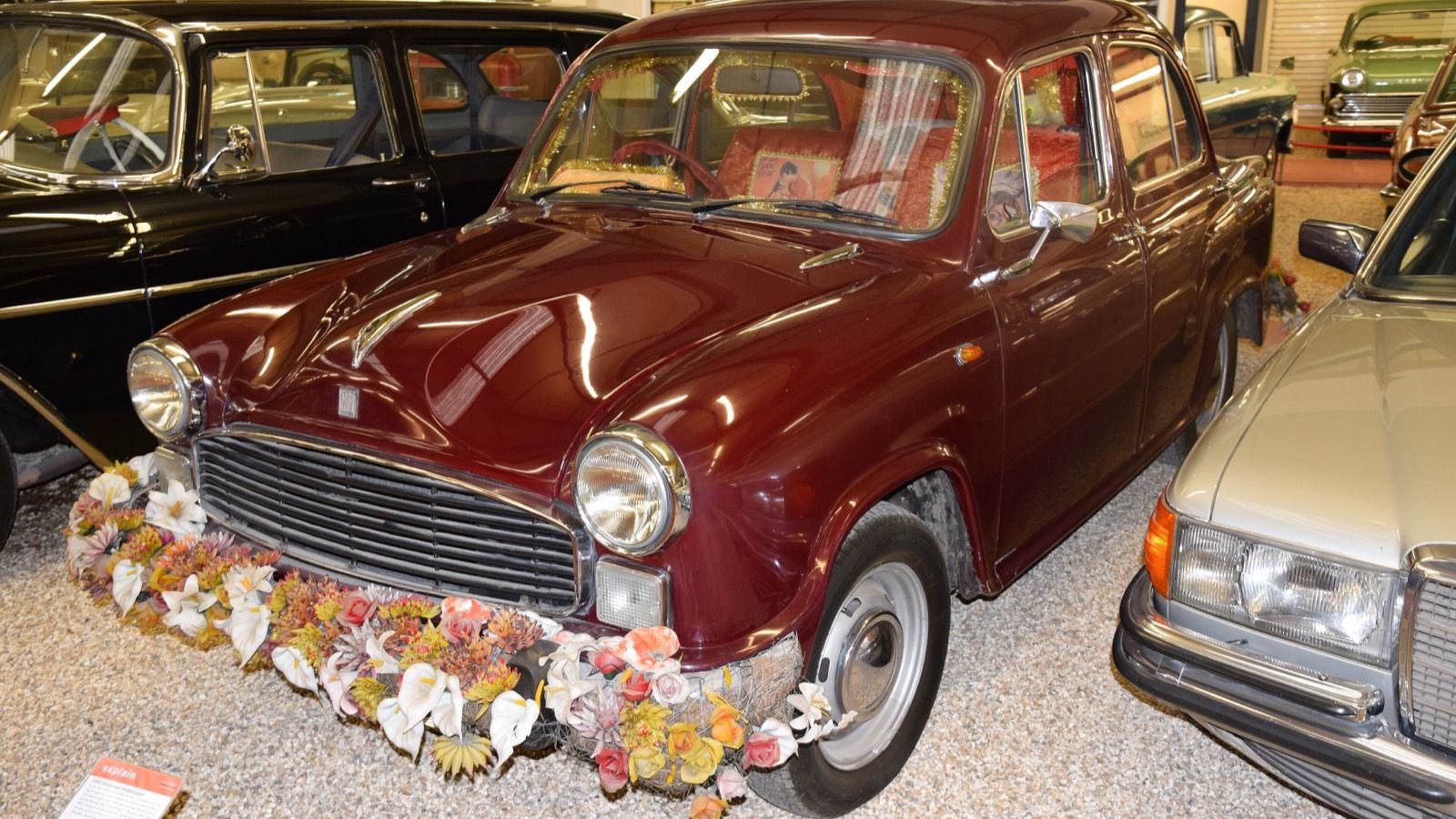
1992 Photo: “File:1992 Hindustan Ambassador (34445497424).jpg” by Hugh Llewelyn from Keynsham, UK / Wikimedia Commons, licensed under CC BY-SA 2.0. Cropped to 16:9.
Classic / Grand / Encore · Classic
Classic gained modern Isuzu petrol engine; Grand (2003) introduced 137 engineering changes; final Encore (2013–2014) developed with Magna Steyr.
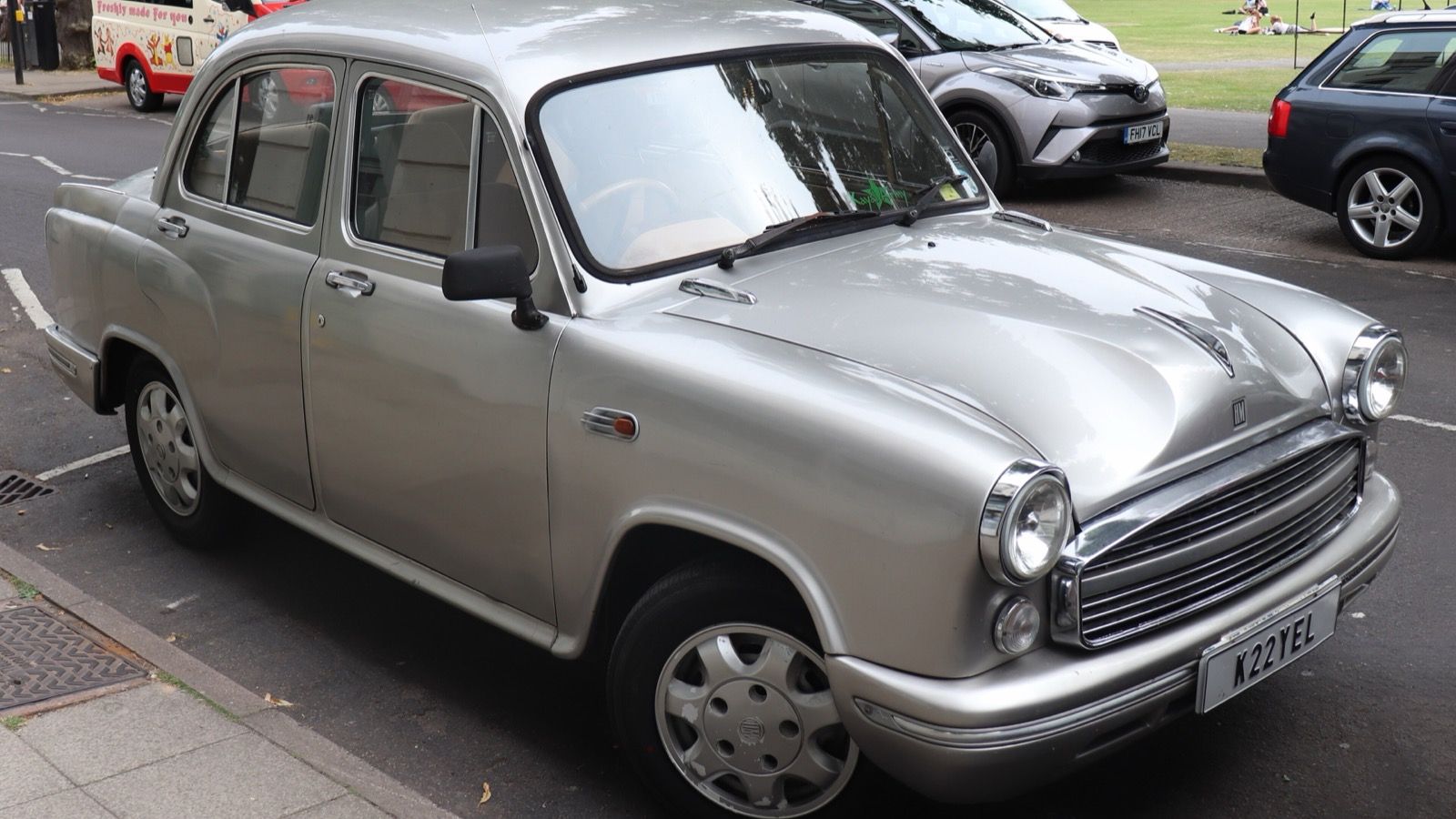
2005 Photo: “File:2005 Hindustan Ambassador Grand BS-3 1800 ISZ MPFI Front (1).jpg” by Vauxford / Wikimedia Commons, licensed under CC BY-SA 4.0. Cropped to 16:9.
Body styles
- Saloon
- Estate
Notable special editions & performance variants
Ambassador Grand
Significantly revised Ambassador with 137 engineering changes over the Classic, plus a 2.0-litre diesel option.
Ambassador Encore
Final Ambassador variant, developed with Austria's Magna Steyr; turbocharged 1,489 cc diesel engine.
Related models
Collect the nameplate
Find a scale model of the Hindustan Motors Ambassador
Search Amazon across available years, colors, and scales. Exact releases vary, so confirm the listing before ordering.