
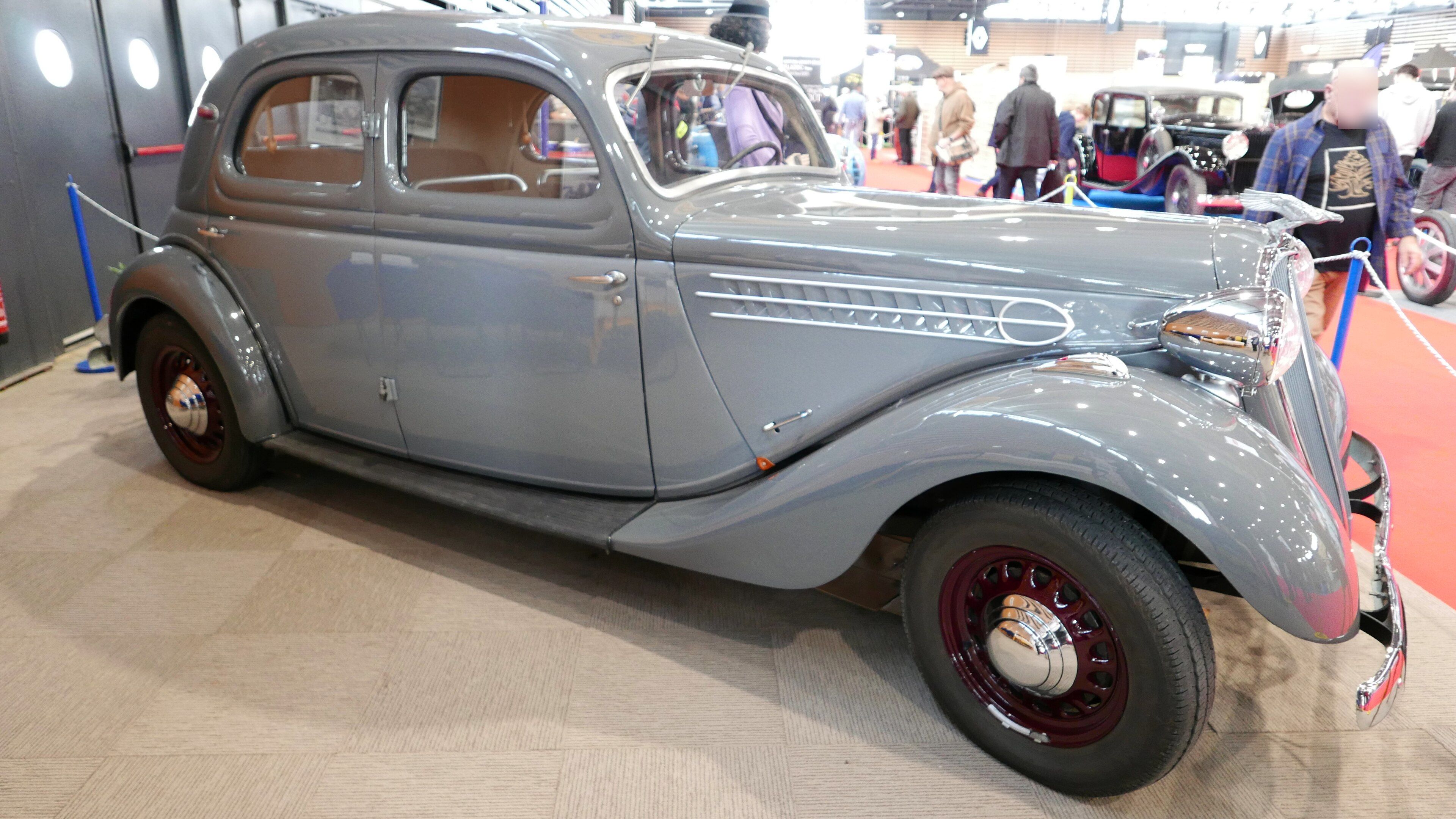
Chenard-Walcker Aigle History
Chenard-Walcker's last model family — an eagle-badged range from the spartan Aiglon four-cylinder up to the V8-powered Aigle 22.
Photo: “2024 époqu'auto 293 Chenard & Walcker Aigle 22 type F 22 1937c” by Finoskov / Wikimedia Commons, licensed under CC BY-SA 4.0
History
Launched at the 1933–34 Paris Salon, the Aigle (French for 'Eagle') family was the final attempt to revive Chenard-Walcker's fortunes. The range was tiered: the Aiglon ('Eaglet') was the entry-level four-cylinder car aimed at the volume market, while larger-engined Aigle 4, Aigle 8, and — at the top — Aigle 22 variants carried six-cylinder and V8 powertrains.
The Super Aigle 4, engineered with help from Jean-Albert Grégoire, introduced front-wheel drive using Tracta constant-velocity joints and fully independent suspension — genuinely advanced for 1934. However it reached the market simultaneously with Citroën's landmark Traction Avant and was considerably more expensive, making commercial success impossible.
By 1936 the company was bankrupt; body manufacturer Chausson took it over and continued limited car production using Citroën and Ford V8 engines under badge-engineered arrangements with Matford. Car production finally wound down in 1939–40, leaving Chausson to carry on the Chenard-Walcker name in trucks and buses into the 1970s.
Generations
First generation · Aigle / Aiglon
Independent Chenard-Walcker production: four-cylinder Aiglon entry model through V8 Aigle 22; Super Aigle 4 introduced Grégoire FWD.
Second generation · Chausson-era Aigle
Photo: “2024 époqu'auto 293 Chenard & Walcker Aigle 22 type F 22 1937c” by Finoskov / Wikimedia Commons, licensed under CC BY-SA 4.0
Post-bankruptcy, built by Chausson with Citroën or Ford V8 engines; bodies shared with Matford, distinguished only by the grille. Car production wound down as existing stock sold off (sources vary; ~1939–40).
1937 Photo: “2024 époqu'auto 293 Chenard & Walcker Aigle 22 type F 22 1937c” by Finoskov / Wikimedia Commons, licensed under CC BY-SA 4.0
Body styles
- Saloon
- Cabriolet
- Coach
Related models
Collect the nameplate
Find a scale model of the Chenard-Walcker Aigle
Search Amazon across available years, colors, and scales. Exact releases vary, so confirm the listing before ordering.