
Standard Motors (India) Standard Gazel History
India's first domestically redesigned car — a thorough rework of the Herald platform with new body, suspension, and interior, built 1972–1983.
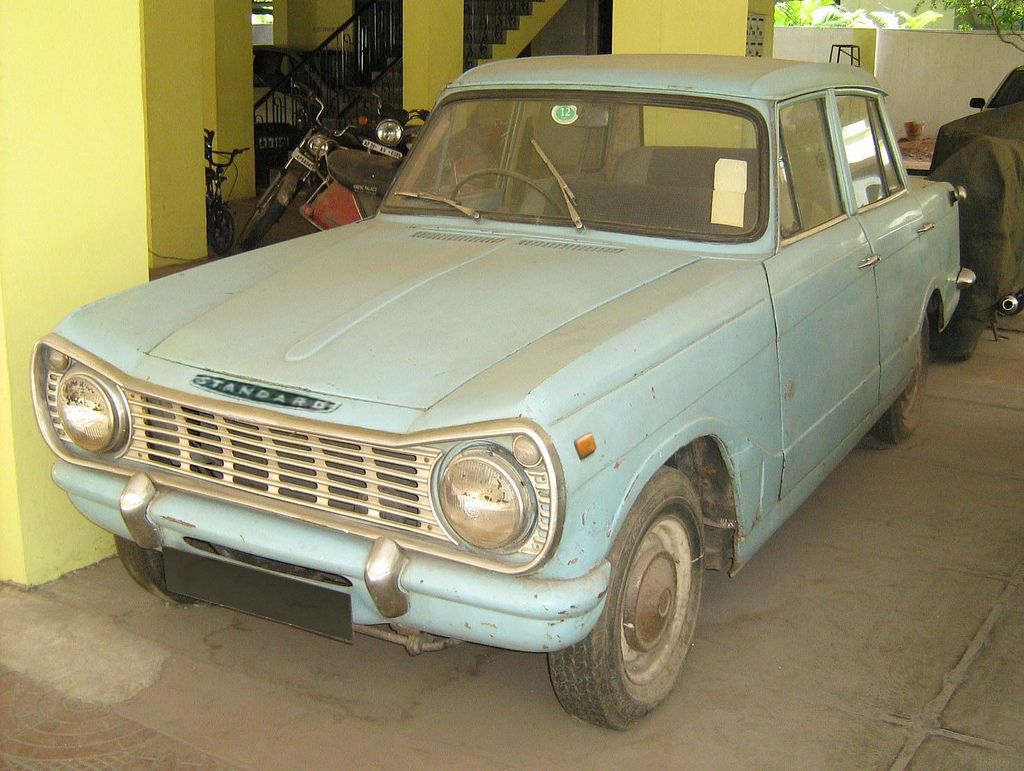
Photo: “Standard Gazel mk2.jpg” by eskaycee / Wikimedia Commons, licensed under CC BY-SA 2.0
History
When Standard parted ways with Triumph in 1970, the Madras design team under Naseer Hussein redesigned the Herald from the ground up. The Gazel (1972) retained the 948 cc four-cylinder and front suspension from the Herald but gained an entirely new body, a revised front fascia, rectangular taillights replacing the Herald's fins, and a more complex rear suspension — a rigid axle on coil-over shocks with an anti-roll bar, replacing the Herald's three-part swing axle. It was India's first car redesigned and re-engineered domestically.
The original Gazel used a forward-lifting front end inherited from the Herald. A Mark II appeared in 1974 with a conventional rear-hinged bonnet and revised interior featuring a one-piece fibreglass dashboard and a bench front seat. The 948 cc engine and basic mechanicals carried over unchanged.
Production peaked at roughly 3,000 units annually in the early 1970s before falling sharply — only 161 cars left the factory in 1976. Sporadic output continued after formal production wound down around 1978–1979, with twelve additional units built in the early 1980s and a single final car completed in 1983. The Gazel's commercial failure reflected both the car's dated mechanicals and the formidable dominance of the Hindustan Ambassador in India's tightly licensed market.
Generations
Mark I
Forward-lifting front end inherited from the Herald; new body, new rear suspension; 948 cc engine.
Mark II
Photo: “Standard Gazel mk2.jpg” by eskaycee / Wikimedia Commons, licensed under CC BY-SA 2.0
Conventional rear-hinged bonnet; fibreglass one-piece dashboard; bench front seat; sporadic production after ~1979.
Body styles
- Sedan
Related models
Collect the nameplate
Find a scale model of the Standard Motors (India) Standard Gazel
Search Amazon across available years, colors, and scales. Exact releases vary, so confirm the listing before ordering.