
Piccard-Pictet 20/24 hp Touring Four History
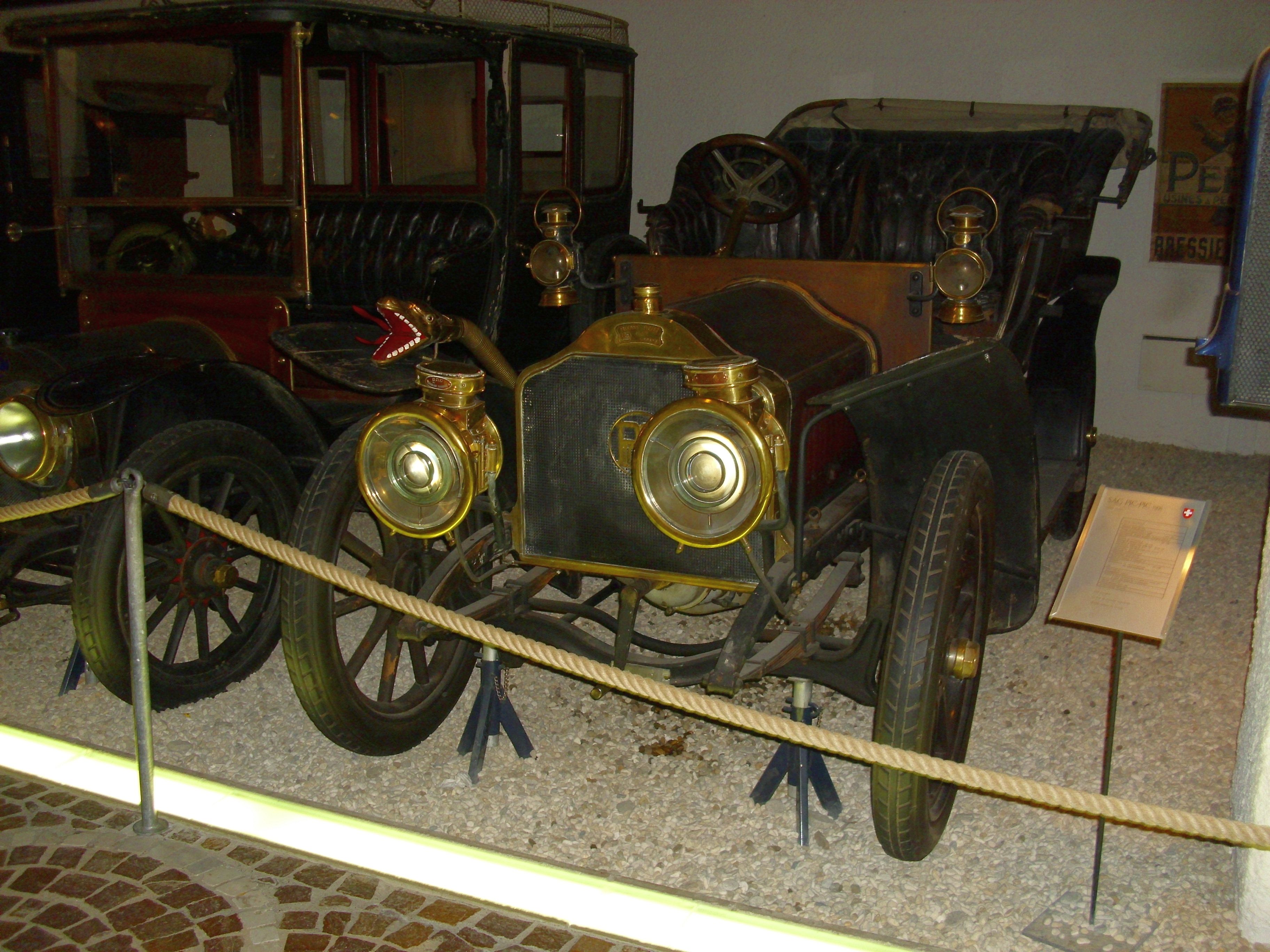
The founding Pic-Pic — a Marc Birkigt-designed inline-four tourer badged 'S.A.G.' that launched the marque at the 1906 Geneva show.
Photo: “SAG 1906.JPG” by Buch-t / Wikimedia Commons — Public domain
History
When Piccard-Pictet et Cie decided to enter car manufacturing in 1906, it engaged Marc Birkigt — the brilliant Swiss engineer already designing Hispano-Suiza engines in Barcelona — to create the first chassis. The result was a well-engineered 20/24 hp inline four, notable for pressure lubrication, magneto ignition, a disc clutch, and propshaft drive at a time when chain drive was still common.
Because Lucien Pictet had arranged to sell Hispano-Suizas in Switzerland, the cars wore the badge of the Société des Automobiles à Genève (S.A.G.) rather than the factory's own name, to avoid any commercial conflict. A larger 35/40 hp four sat alongside it in the early catalogue, and a 28/32 hp six was added for 1907.
These early S.A.G. cars established the marque's reputation for mechanical refinement and durability, earning it the popular epithet 'the Rolls-Royce of Switzerland'. By the time the brand was reorganised as Piccard-Pictet et Cie around 1910, the cars had a loyal Swiss following among wealthy buyers. The 20/24 hp remained catalogued into the early 1910s, though the exact year the reworked poppet-valve 20 hp variants superseded it is unrecorded (sources vary; c.1911).
Generations
S.A.G. 20/24 hp (1906–1911) · 20/24 hp
Photo: “SAG 1906.JPG” by Buch-t / Wikimedia Commons — Public domain
Marc Birkigt-designed 20/24 hp inline four badged 'S.A.G.', with pressure lubrication, magneto ignition, a disc clutch and shaft drive — the car that launched the marque.
1906 Photo: “SAG 1906.JPG” by Buch-t / Wikimedia Commons — Public domain
Body styles
- Touring car
- Landaulet
Related models
Collect the nameplate
Find a scale model of the Piccard-Pictet 20/24 hp Touring Four
Search Amazon across available years, colors, and scales. Exact releases vary, so confirm the listing before ordering.