
Piccard-Pictet 30 hp Sleeve-Valve Tourer History
Catalog record
Photography for this nameplate has not yet cleared the archive’s licensing and identity checks. The researched text below remains available while the page stays out of search and advertising inventory.
History
In 1912 Piccard-Pictet became one of the first European manufacturers to licence the Burt-McCollum single-sleeve-valve engine design from Argyll of Scotland. The sleeve-valve engine replaced conventional poppet valves with a sliding sleeve between the piston and cylinder wall, eliminating valve noise and reducing carbon build-up. The arrangement was regarded as the pinnacle of refinement for touring-car engines of the era.
The 30 hp sleeve-valve model — offered in sporting touring, four-seater victoria, and formal landaulet coachwork — attracted wealthy Swiss and British clientele who prized near-silent running. Contemporary poppet-valve Pic-Pics (a 16 hp and two 20 hp variants with different strokes) continued alongside it for cost-conscious buyers, giving the range a clear luxury and standard tier.
The Swiss Army's mass adoption of Pic-Pic cars during World War I — ordering them as standard staff cars for their proven reliability in Alpine terrain — sustained the factory through the war years even as civilian demand contracted. Racing versions of the sleeve-valve cars also competed at the 1914 French Grand Prix at Lyon, driven by Tournier and Thomas Clarke.
Generations
30 hp Sleeve-Valve (1912–1920) · 30 hp Sleeve-Valve
An early adopter of the licensed Burt-McCollum single-sleeve-valve engine, prized for near-silent running; racing versions with front brakes ran the 1914 French Grand Prix.
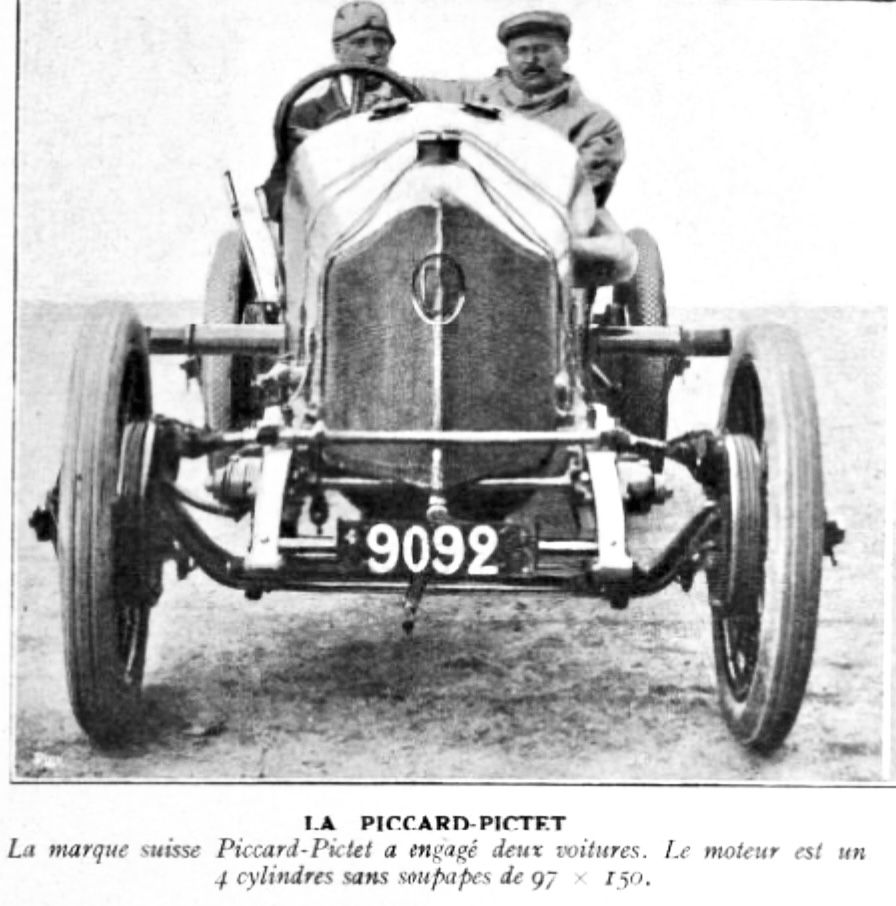
1914 Photo: “Pic-Pic racing car (1914).jpg” by La Vie au grand air : revue illustrée de tous les sports / Wikimedia Commons — Public domain
Body styles
- Touring car
- Four-seater Sporting Victoria
- Landaulet
Notable special editions & performance variants
1914 Grand Prix racer
Two sleeve-valve Pic-Pics with front brakes — a technical novelty at the time — entered the 1914 French Grand Prix at Lyon; neither finished, but their specification (including front-wheel brakes) was ahead of most rivals.
Related models
Collect the nameplate
Find a scale model of the Piccard-Pictet 30 hp Sleeve-Valve Tourer
Search Amazon across available years, colors, and scales. Exact releases vary, so confirm the listing before ordering.