
Morgan Three-Wheeler History
The car that founded Morgan — light, V-twin-powered three-wheelers (1910–1952) that dominated early cyclecar racing.
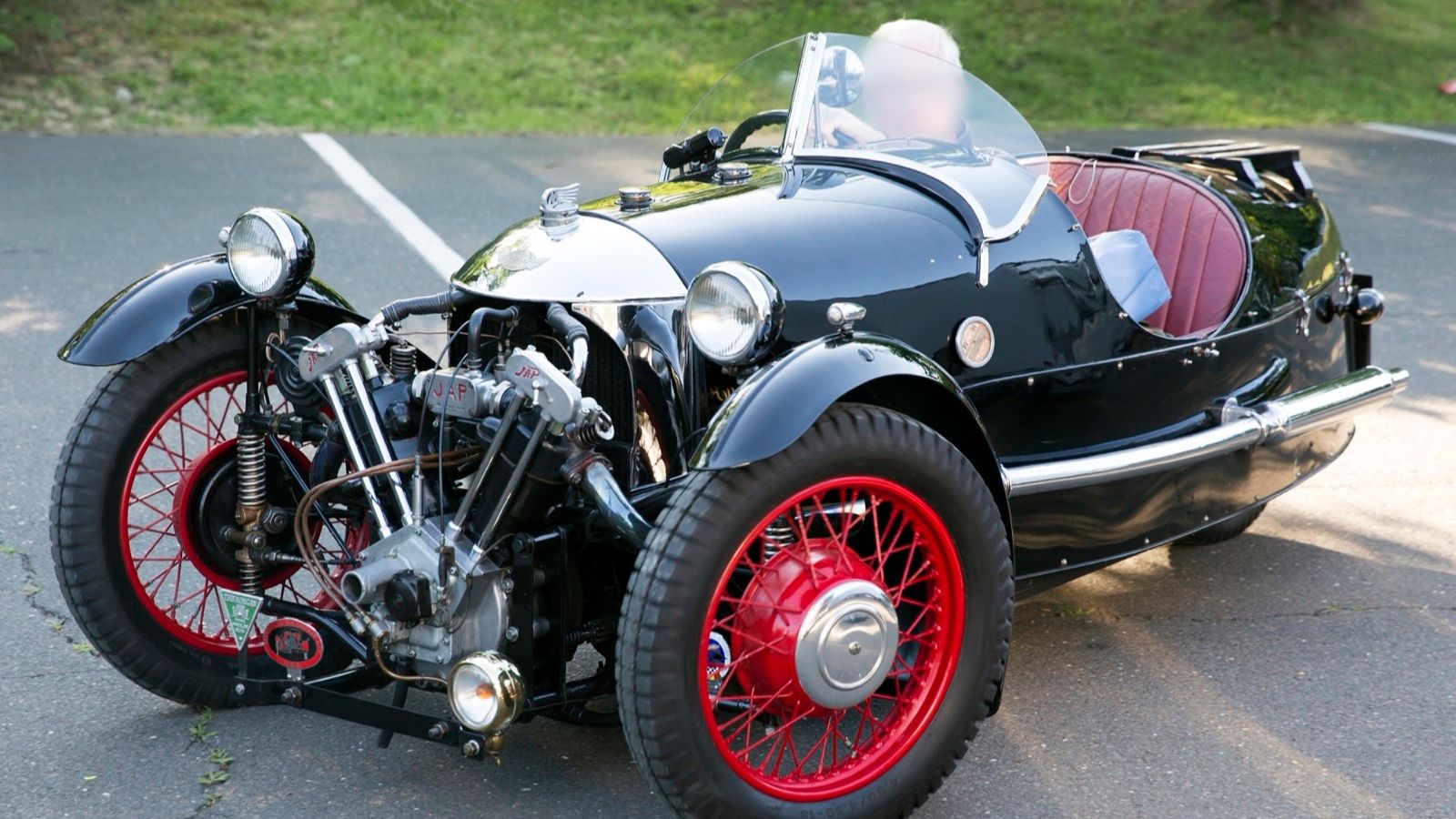
Photo: “File:1934 Morgan Super Sports at Greenwich, front left.jpg” by Mr.choppers / Wikimedia Commons, licensed under CC BY-SA 3.0. Cropped to 16:9.
History
Morgan began with the three-wheeler: H.F.S. Morgan built his first single-seat Runabout in 1909 and put a production version on show at the 1910 Olympia Motorcycle Exhibition, founding the company that year. The early cars used a big air-cooled motorcycle V-twin mounted ahead of the front axle, a tubular chassis, and a single driven rear wheel — light, cheap to tax as a cyclecar, and very fast for their power.
Through the 1910s and 1920s the V-twin Morgans were formidable in cyclecar competition, setting records at Brooklands and winning their class in events across Britain and France, which built the marque's sporting reputation. The line ran in two main families: the V-twin three-wheelers (roughly 1911–1939) and, from 1932, the F-Series, which swapped the exposed V-twin for an inline Ford four mounted within the frame.
Three-wheeler production ended in 1952 as Morgan committed to its new four-wheeled cars, closing the marque's founding chapter after more than four decades. The configuration would not return to the catalogue until the modern 3 Wheeler revival six decades later.
Generations
V-twin three-wheelers · Runabout / V-twin cyclecars
Photo: “File:1934 Morgan Super Sports at Greenwich, front left.jpg” by Mr.choppers / Wikimedia Commons, licensed under CC BY-SA 3.0. Cropped to 16:9.
Air-cooled motorcycle V-twin mounted ahead of the front axle, driving a single rear wheel; the record-setting cyclecar-racing Morgans of the 1910s–1930s.
1934 Photo: “File:1934 Morgan Super Sports at Greenwich, front left.jpg” by Mr.choppers / Wikimedia Commons, licensed under CC BY-SA 3.0. Cropped to 16:9.
F-Series · Ford-engined F-Series
Replaced the exposed V-twin with an inline Ford four-cylinder engine carried within the chassis; the last of the original three-wheelers, ending in 1952.
Body styles
- Two-seat runabout
- Four-seat family
- Sports two-seater
Related models
Collect the nameplate
Find a scale model of the Morgan Three-Wheeler
Search Amazon across available years, colors, and scales. Exact releases vary, so confirm the listing before ordering.