
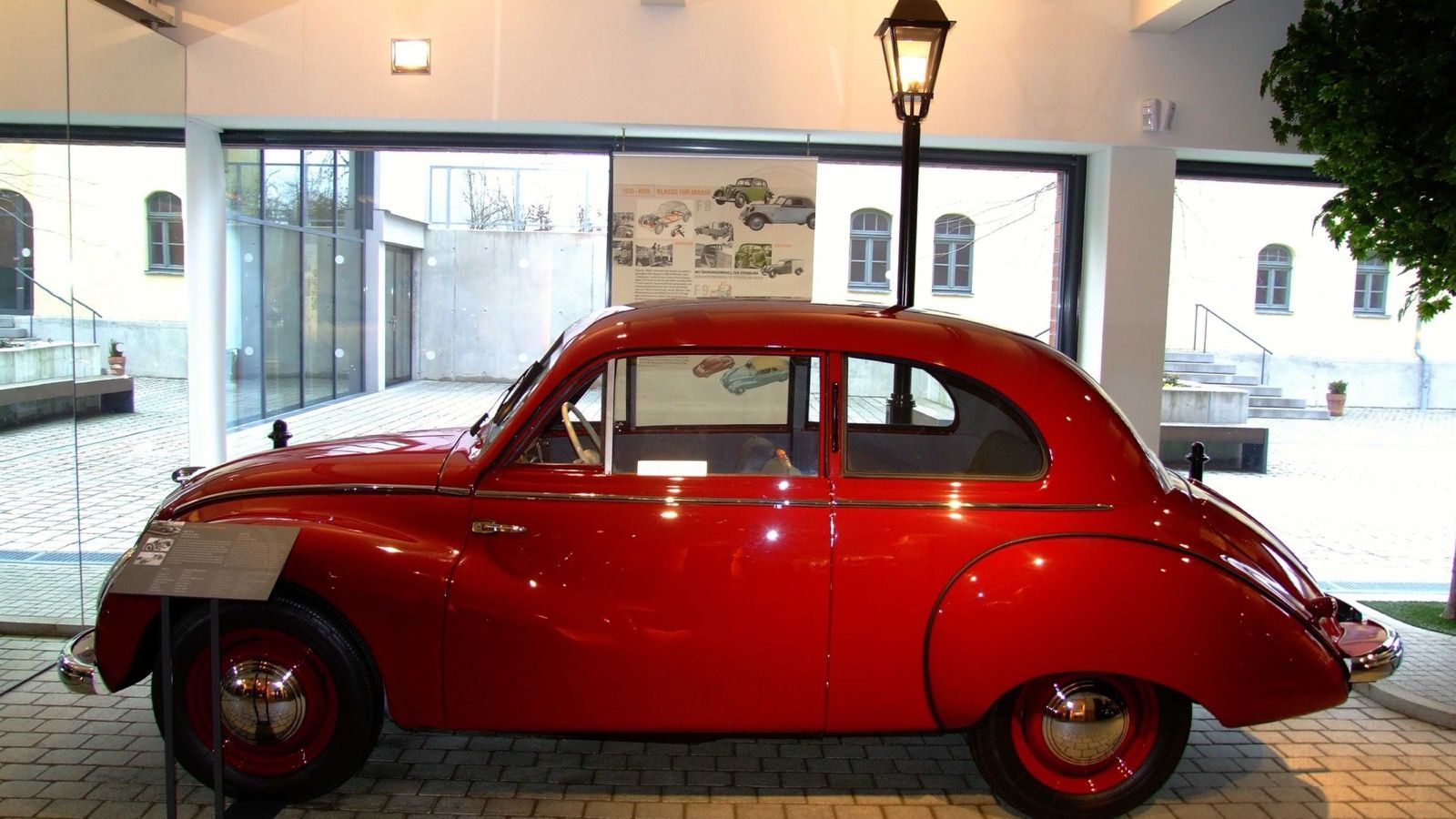
IFA F9 History
IFA's three-cylinder compact — a more modern sibling to the F8, using a prewar DKW prototype body and 910 cc engine; its underpinnings went on to underpin the Wartburg 311.
Photo: “File:August Horch Museum Zwickau - gravitat-OFF - ifa f9.jpg” by gravitat-OFF from Germany / Wikimedia Commons, licensed under CC BY 2.0. Cropped to 16:9.
History
The IFA F9 was based on a DKW prototype of the same name that had been developed in the late 1930s as the intended replacement for the F8 but never reached production before World War II intervened. Resuming development under Soviet/East German state control, the F9 entered production at Zwickau in 1950. Unlike the F8's carry-over 1930s body, the F9 adopted the more contemporary styling of that prewar prototype, making it look closer to contemporary West German DKW products.
Power came from a three-cylinder two-stroke water-cooled engine displacing approximately 910 cc and producing around 28 bhp (21 kW) — a notable step up from the F8's two-cylinder unit. An unusual rear-mounted radiator configuration was a distinguishing engineering detail. The car was available as a two-door saloon, cabriolet, and three-door estate, though surviving examples are predominantly saloons.
In 1953, production transferred from Zwickau to Eisenach, where vehicles were briefly rebadged as the EMW 309. Production of the F9 line ended in April 1956 with approximately 40,663 units built in total. The F9's underpinnings were subsequently developed into the Wartburg 311, which went on to a long production run at Eisenach as East Germany's mid-range car alongside the Trabant.
Generations
Zwickau build · IFA F9 (Zwickau)
Photo: “File:August Horch Museum Zwickau - gravitat-OFF - ifa f9.jpg” by gravitat-OFF from Germany / Wikimedia Commons, licensed under CC BY 2.0. Cropped to 16:9.
Original production at the Zwickau plant; used the prewar DKW F9 prototype body with a 910 cc three-cylinder two-stroke engine and rear-mounted radiator.
Eisenach build / EMW 309 · IFA F9 / EMW 309 (Eisenach)
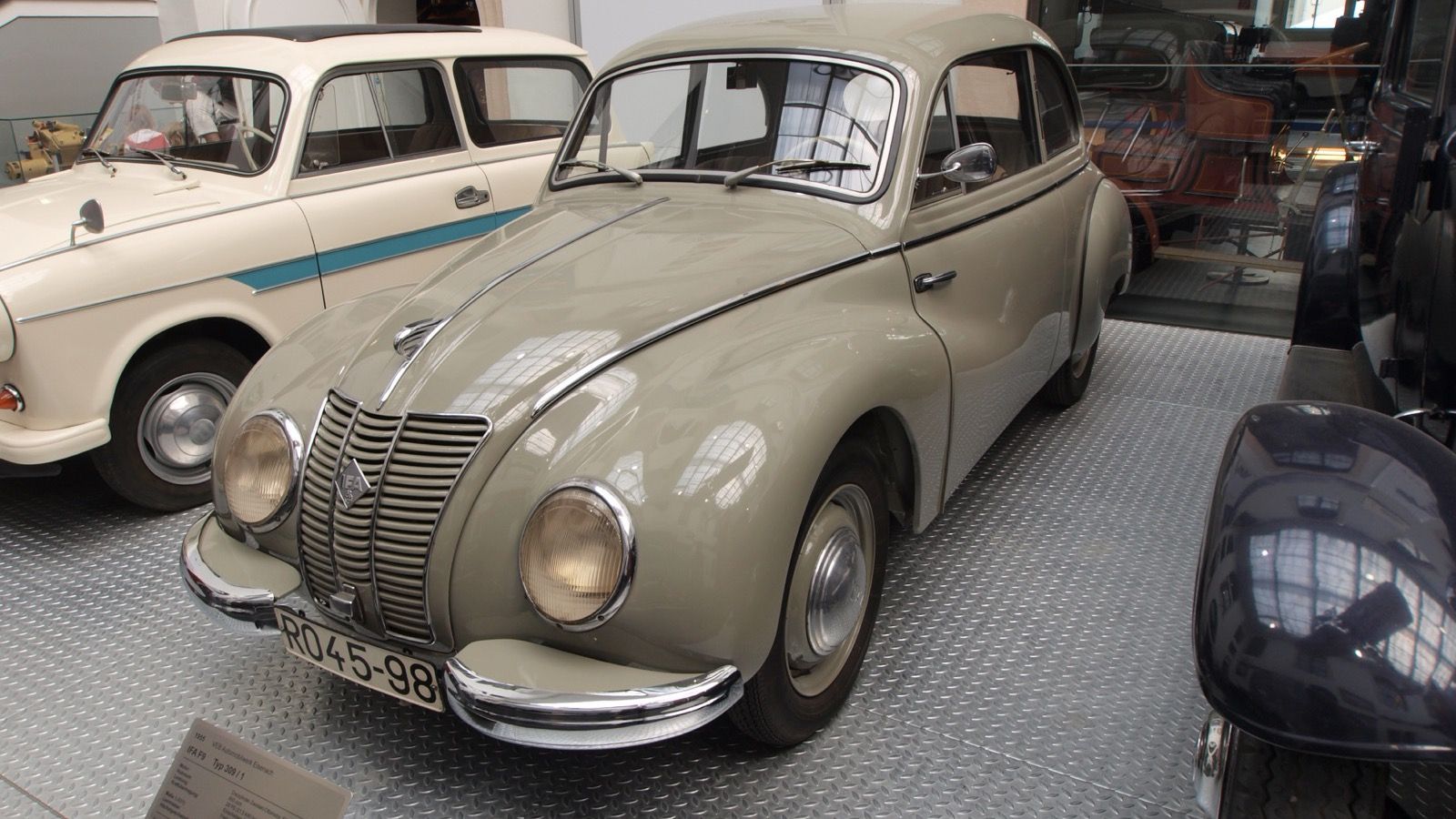
Photo: “File:1955 VEB IFA F9 Type 309-1 pic1.JPG” by Alf van Beem / Wikimedia Commons — CC0 1.0. Cropped to 16:9.
Production moved to Eisenach where cars were sold as the EMW 309; incorporated plastic panels for weight reduction, previewing Wartburg construction. Ended April 1956.
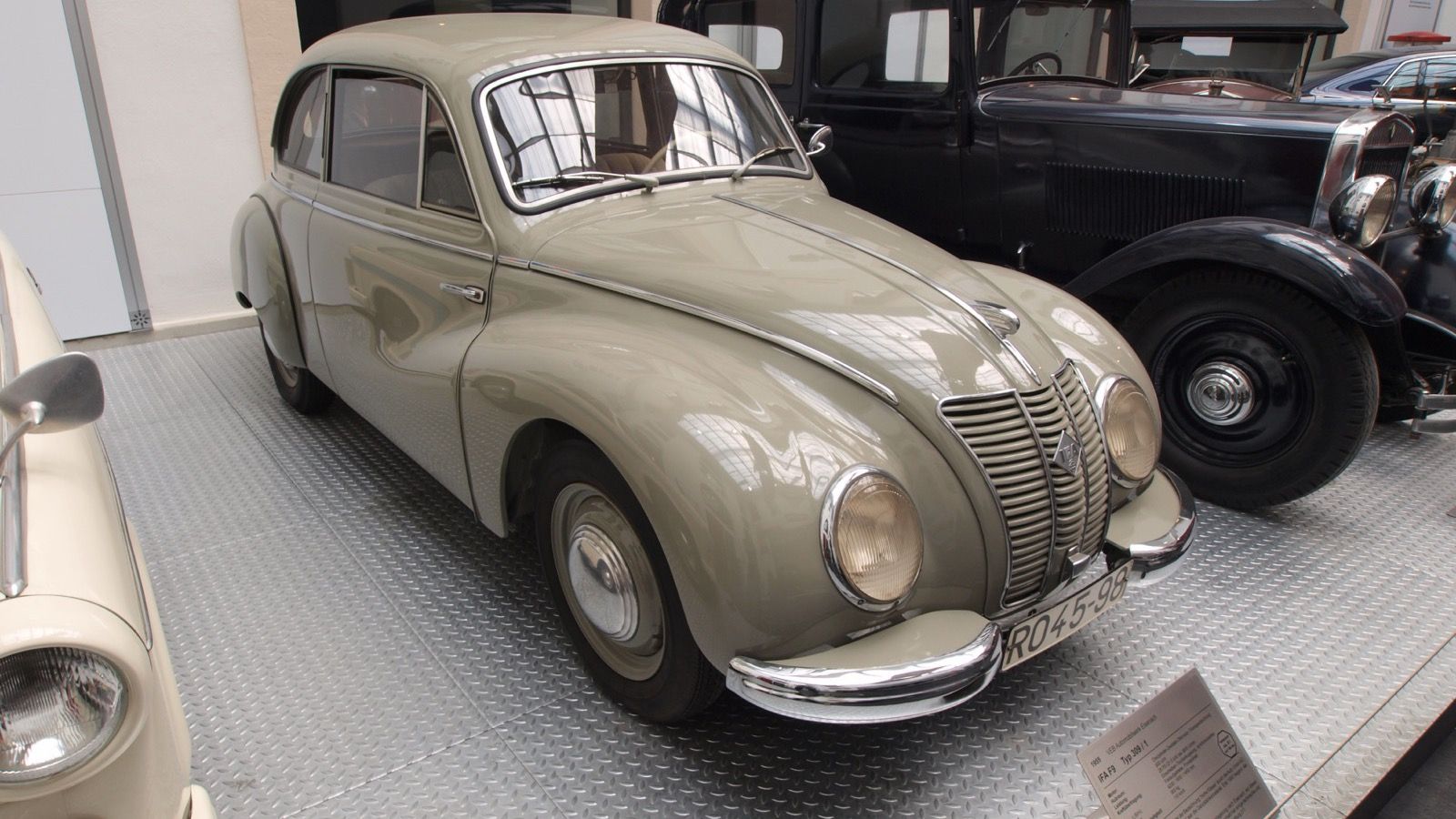
1955 Photo: “File:1955 VEB IFA F9 Type 309-1 pic3.JPG” by Alf van Beem / Wikimedia Commons — CC0 1.0. Cropped to 16:9.
Body styles
- Sedan
- Cabriolet
- Estate
Related models
Collect the nameplate
Find a scale model of the IFA F9
Search Amazon across available years, colors, and scales. Exact releases vary, so confirm the listing before ordering.