
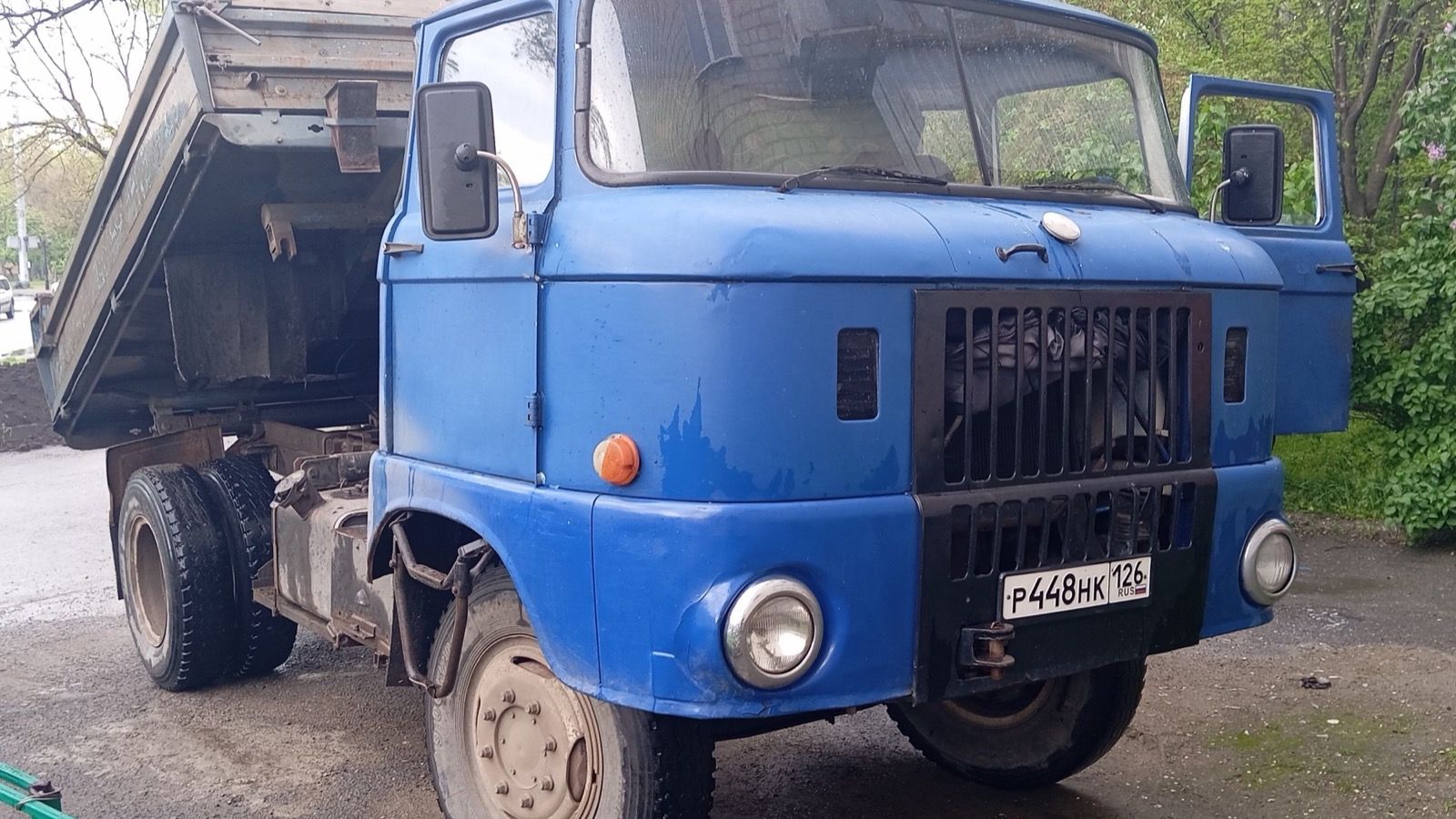
IFA W 50 History
East Germany's most prolific truck — nearly 572,000 built at Ludwigsfelde between 1965 and 1990 in over sixty factory variants.
Photo: “File:Classic truck IFA W50L.jpg” by Elveres / Wikimedia Commons, licensed under CC BY-SA 4.0. Cropped to 16:9.
History
Development of what became the W 50 began in the late 1950s at Kraftfahrzeugwerk 'Ernst Grube' Werdau, tasked with replacing the ageing IFA W3 and S4000-1 medium trucks. The project went through several designations (S4500, W45) before the target payload was raised to five tonnes and the name settled on W 50 — 'W' for Werdau, '50' for five tonnes. A Ministerrat decision in December 1962 transferred production to the VEB Industriewerke Ludwigsfelde (IWL), south of Berlin, where a vast new factory was built; the production hall complex was the largest in the DDR at roughly 130,000 m² of floor area.
The first W 50 rolled off the line on 17 July 1965. For its first two years the truck used a revised version of the S4000-1's swirl-chamber diesel (110 PS); from 1967 a direct-injection 4 VD 14.5/12-1 SRW unit producing 125 PS at 2,300 rpm replaced it, and that engine remained in production through 1990. Two wheelbase options (3.2 m and 3.7 m) supported around sixty factory-catalogued body variants — flatbeds, tippers, fire engines (including the well-known LF16 fire appliance), ambulances, street sweepers, and the military four-wheel-drive LA 4×4 variant with balloon tyres that was widely used by the National People's Army and civil defence.
Production peaked at 32,516 units in 1986. When the IFA L 60 entered production in June 1987 as the intended successor, slow L 60 sales kept both trucks in production simultaneously. German reunification ended all IFA commercial-vehicle production on 17 December 1990; final W 50 output totalled approximately 571,831–572,000 vehicles. The W 50 remains a common sight at vintage vehicle rallies across Germany and Eastern Europe.
Generations
First series · W 50 / 4 KVD engine
Launch variant with the swirl-chamber 4 KVD 14.5/12 diesel (110 PS); two wheelbase options, initial flatbed and tipper bodies.
Production series · W 50 / 4 VD engine
Photo: “File:Classic truck IFA W50L.jpg” by Elveres / Wikimedia Commons, licensed under CC BY-SA 4.0. Cropped to 16:9.
Direct-injection 4 VD 14.5/12-1 SRW diesel (125 PS) replaced the swirl-chamber unit; ~60 body variants developed over 23 years through to the end of DDR vehicle production.
Body styles
- Flatbed truck
- Tipper
- Box van
- Fire engine
- Ambulance
- Street sweeper
- Military 4x4
Notable special editions & performance variants
W 50 LA (4×4)
Four-wheel-drive military variant with balloon tyres and raised ground clearance, widely used by the National People's Army (NVA) and civil defence organisations.
W 50 LF16 (fire engine)
Tanker/pump fire appliance version built on the W 50 platform; the LF16 TS8 pumper became the standard East German municipal fire truck.
Related models
Collect the nameplate
Find a scale model of the IFA W 50
Search Amazon across available years, colors, and scales. Exact releases vary, so confirm the listing before ordering.