
Holden Commodore History
Catalog record
Photography for this nameplate has not yet cleared the archive’s licensing and identity checks. The researched text below remains available while the page stays out of search and advertising inventory.
History
The Holden Commodore (VB) launched in October 1978 as a replacement for the full-size Kingswood, drawing on Opel Rekord architecture but extensively re-engineered for Australian conditions — Holden claimed only 35 per cent parts commonality with the Rekord. The VB offered six-cylinder and V8 engines in an intermediate-sized body and quickly became Australia's best-selling car.
Successive series through the 1980s and 1990s — VB through VS — refined the formula, gaining new engines (including a Buick-derived 3.8-litre V6 in the VN of 1988 and later the all-aluminium supercharged version) and a steadily improved cabin. The VT of 1997, developed at a cost of A$600 million, was the most significant redesign, introducing a new oval-port 5.7-litre V8 and the LS1 (from the VX of 2000) that would power both the Commodore and the Monaro revival.
The fourth-generation VE (2006) and VF (2013) used a new platform and brought the Commodore to the peak of its development, with Holden Special Vehicles (HSV) producing the GTS as the range-topping performance car — peaking at 577 hp in the Gen-F GTS (2013) and 636 hp in the GTSR W1 (2017). Australian manufacturing ended on 20 October 2017. A final ZB-series Commodore (2018–2020, a rebadged Opel Insignia) was sold briefly as an import before GM retired the Holden marque at the close of 2020.
Generations
First generation (VB–VL) · VB / VC / VH / VK / VL
The Opel-derived originals; VL added the Nissan RB30 six and laid the groundwork for the Group A racing Commodore.
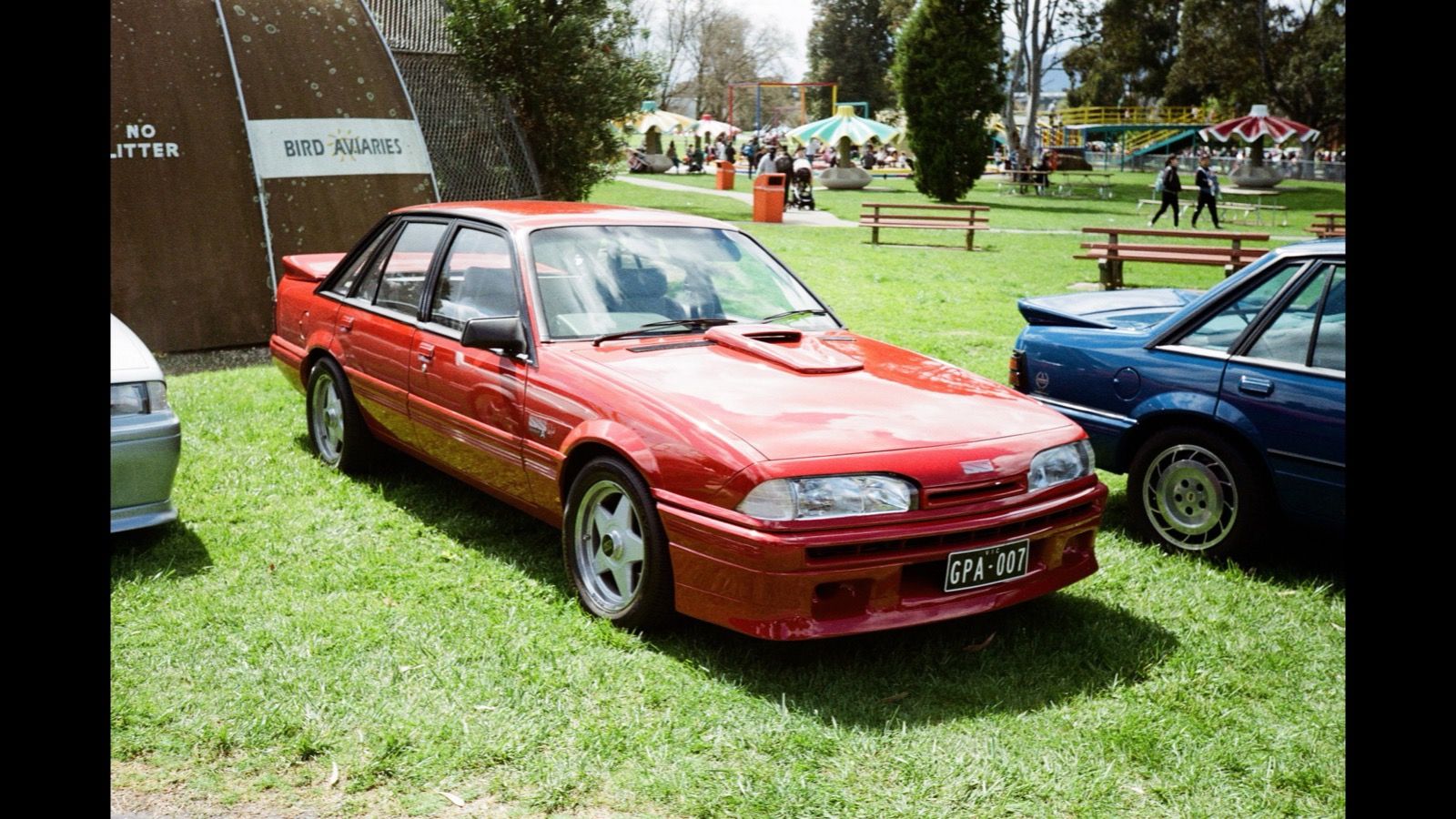
1986 Photo: “1986 Holden Commodore SS Group A (photo 3).jpg” by Matthew Paul Argall / Wikimedia Commons, licensed under CC BY 2.0. Cropped to 16:9.
Second generation (VN–VS) · VN / VP / VR / VS
New 3.8-litre Buick V6 and 5.0-litre V8; HSV performance variants firmly established.
Third generation (VT–VZ) · VT / VX / VY / VZ
A$600 million redesign; LS1 V8 introduced in the VX, powered the Monaro revival and US-export G8.
Fourth generation (VE–VF) · VE / VF
New platform; HSV GTS peaked at 636 hp in the GTSR W1 — the last and most powerful Australian-built Holden.
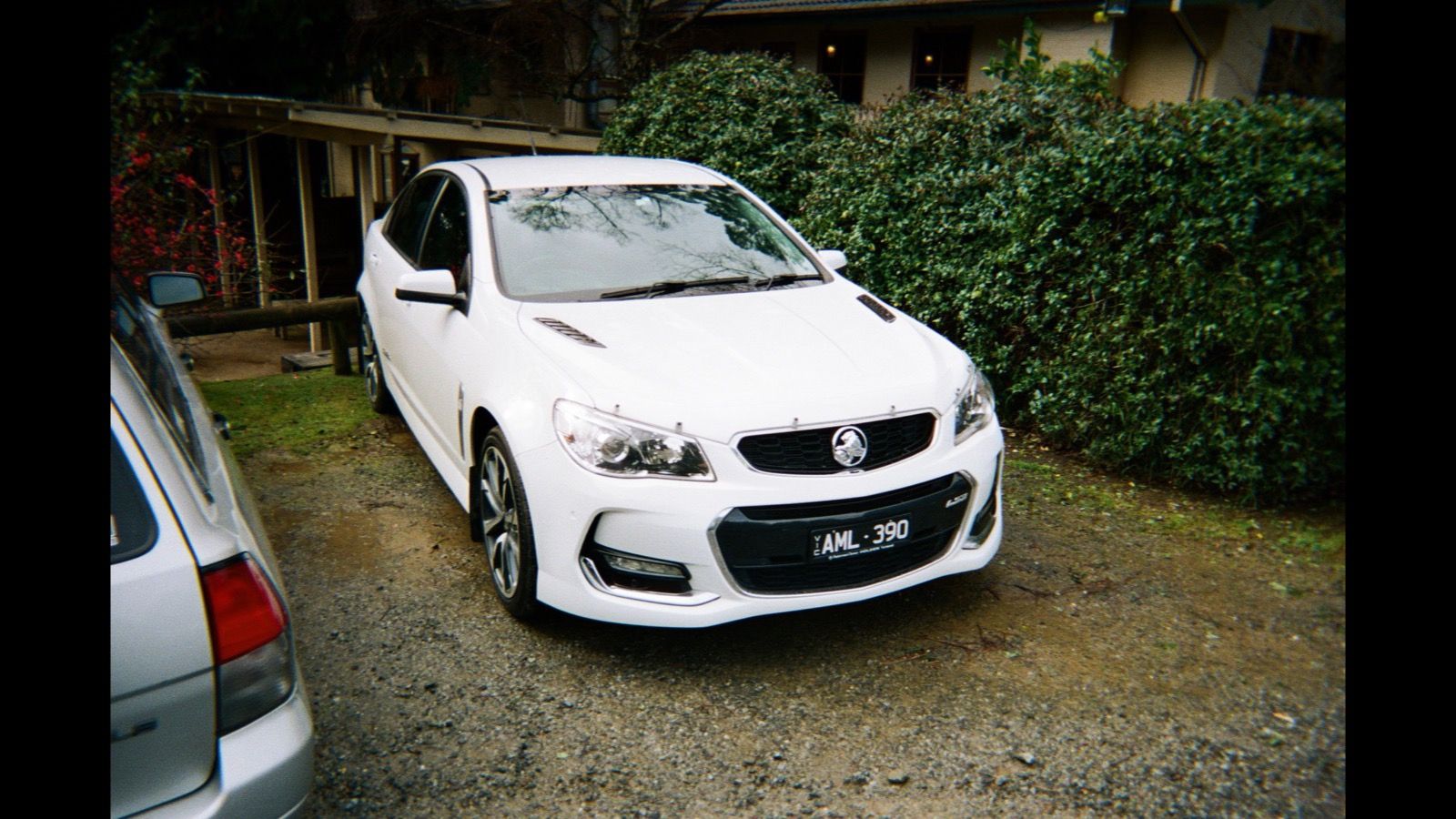
2017 Photo: “2017 Holden Commodore.jpg” by Matthew Paul Argall / Wikimedia Commons, licensed under CC BY 2.0. Cropped to 16:9.
Fifth generation (ZB) · ZB (Opel Insignia-based)
An imported, rebadged Opel Insignia; sold briefly before GM retired the Holden name.
Body styles
- Sedan
- Wagon
- Utility
- Coupe utility
Notable special editions & performance variants
HSV GTS
HSV's flagship performance Commodore — from the VP's 5.0-litre V8 through to the VF Gen-F2's supercharged 6.2-litre LS9 at 577 hp.
HSV GTSR W1
The final Australian-built Holden-based performance car — 636 hp supercharged 6.2-litre LS9, only 300 built; the most powerful Holden ever made.
Commodore SS / SSV
The mainstream V8 performance trim across the VT-through-VF generations — the everyday sporting Commodore below HSV.
Commodore Group A SV (VL)
The VL-based touring-car homologation special — 302 units produced, an all-time collectible.
Related models
Collect the nameplate
Find a scale model of the Holden Commodore
Search Amazon across available years, colors, and scales. Exact releases vary, so confirm the listing before ordering.