
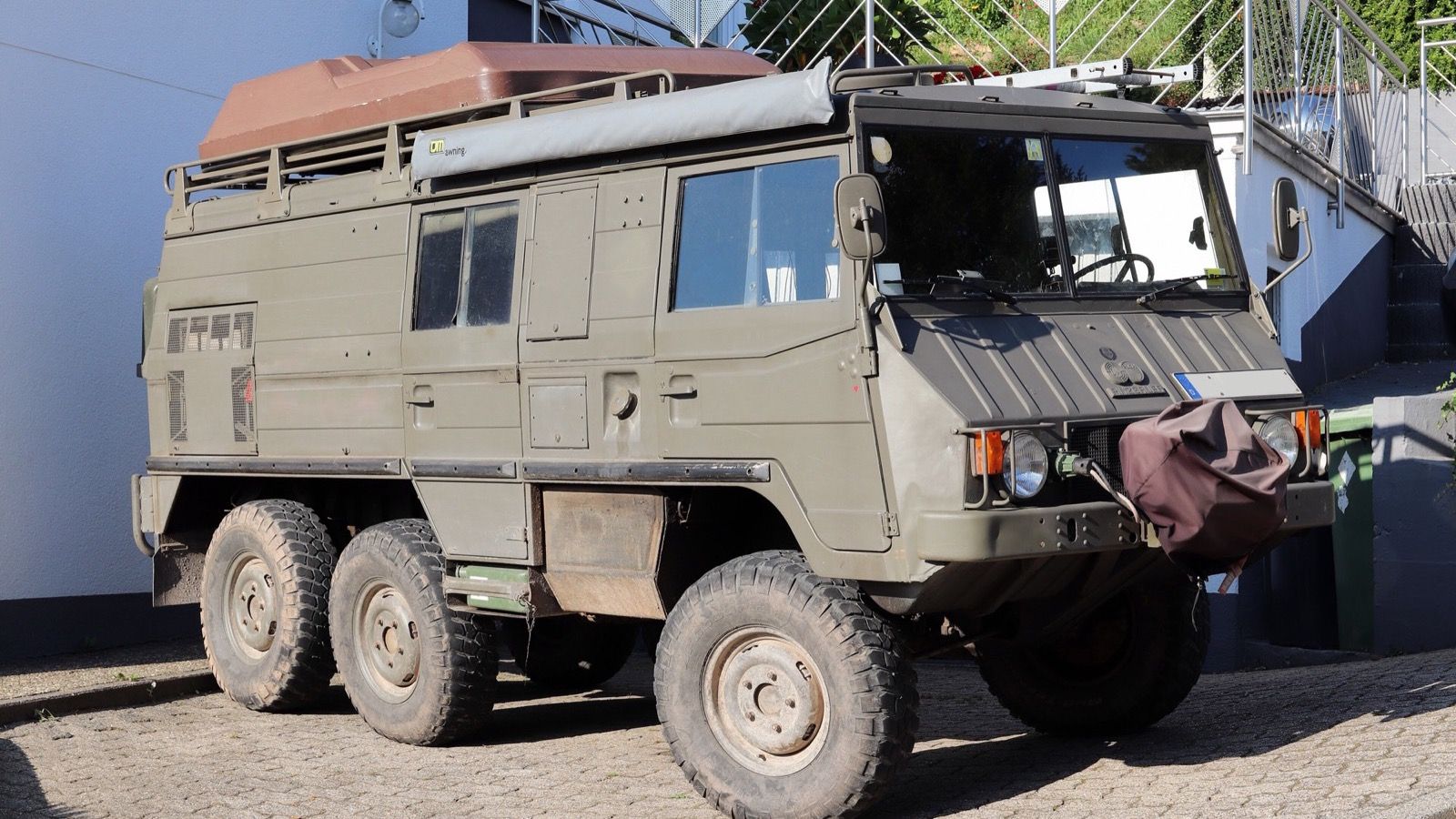
Puch Pinzgauer History
The Haflinger scaled up — a high-mobility 4×4 and 6×6 military utility truck used by armies across the world for three decades.
Photo: “Steyr-Puch Pinzgauer Hirschhorn.jpg” by Joschi71 / Wikimedia Commons, licensed under CC BY-SA 4.0. Cropped to 16:9.
History
Conceived as the Haflinger's larger successor, the Pinzgauer (named for the Pinzgauer cattle breed) was developed through the late 1960s and entered production in 1971. Like the Haflinger it inherited the central-tube chassis and portal-axle layout that gave Steyr-Daimler-Puch vehicles their extraordinary off-road mobility; the Pinzgauer added a more powerful 2.5-litre inline four-cylinder air-cooled engine and was available in both 4×4 (710 series) and 6×6 (712 series) configurations for heavier loads.
The first generation ran from 1971 until 1985, with 18,349 units produced. A substantially revised second generation, developed from 1980 onward, entered production in 1986 and continued through 2000 under Steyr-Daimler-Puch (later briefly Magna Steyr before the model was sold on). Armed forces in Austria, Switzerland, the United Kingdom, and many other nations operated Pinzgauers; the UK's procurement in the 1990s was particularly large. In 2000, Magna Steyr sold the Pinzgauer's production rights to Automotive Technik of the UK; that business passed to Stewart & Stevenson (2005) and then Armor Holdings, and reached BAE Systems only when BAE acquired Armor Holdings in 2007 — under which a modernized armoured variant continued beyond the scope of the original Puch line.
Generations
First generation · 710 / 712 series
Photo: “Steyr-Puch Pinzgauer Hirschhorn.jpg” by Joschi71 / Wikimedia Commons, licensed under CC BY-SA 4.0. Cropped to 16:9.
Original air-cooled 2.5-litre four in 4×4 (710) and 6×6 (712) form; 18,349 built.
Second generation · Pinzgauer II
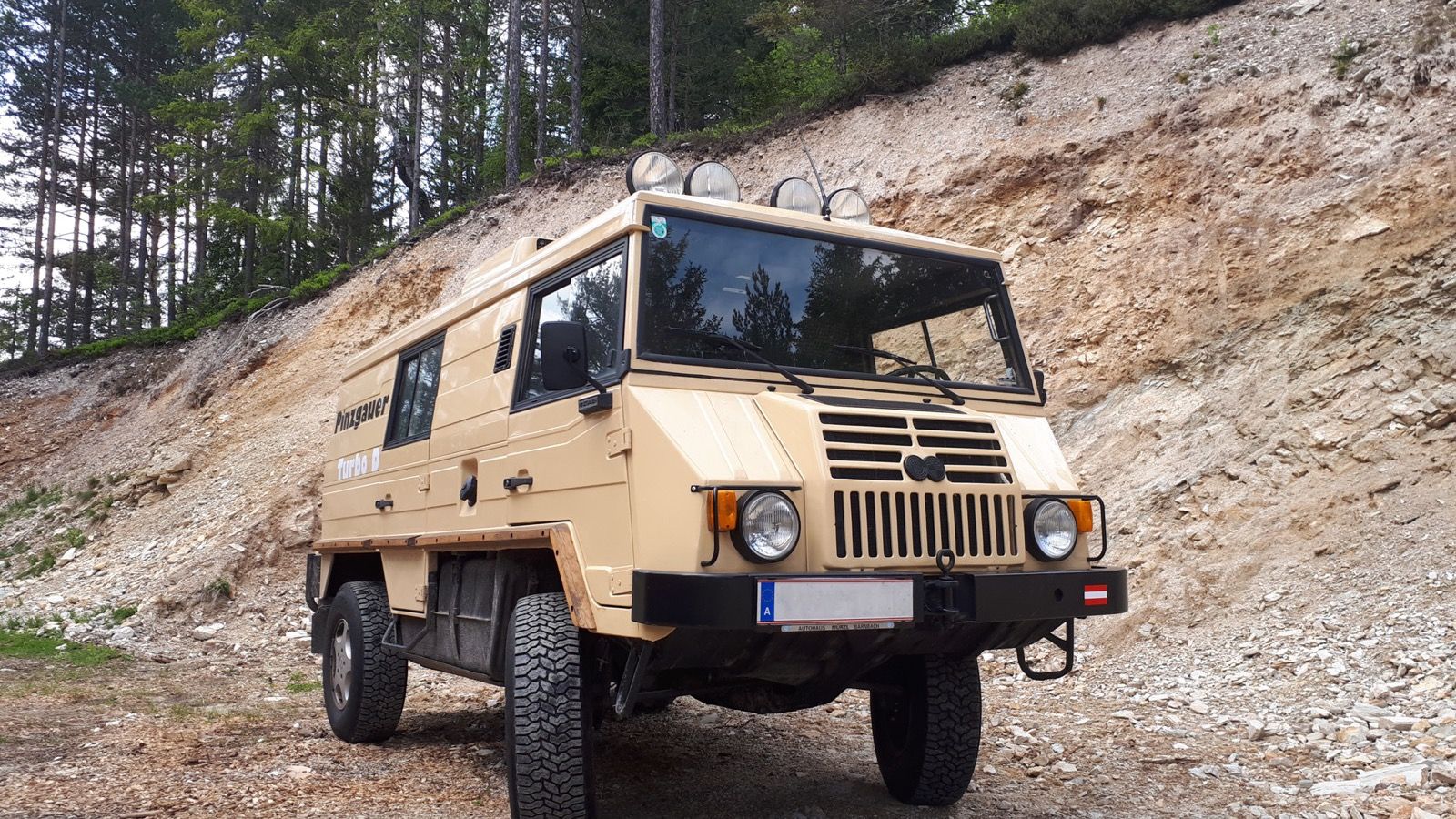
Photo: “Steyr- Puch Pinzgauer Turbo D.png” by ArToxHD / Wikimedia Commons, licensed under CC BY-SA 4.0. Cropped to 16:9.
Revised second-generation vehicle with updated drivetrain; continued under Magna Steyr until further transferred.
Body styles
- 4×4 soft-top
- 4×4 hardtop
- 6×6 truck
- Ambulance
Related models
Collect the nameplate
Find a scale model of the Puch Pinzgauer
Search Amazon across available years, colors, and scales. Exact releases vary, so confirm the listing before ordering.