
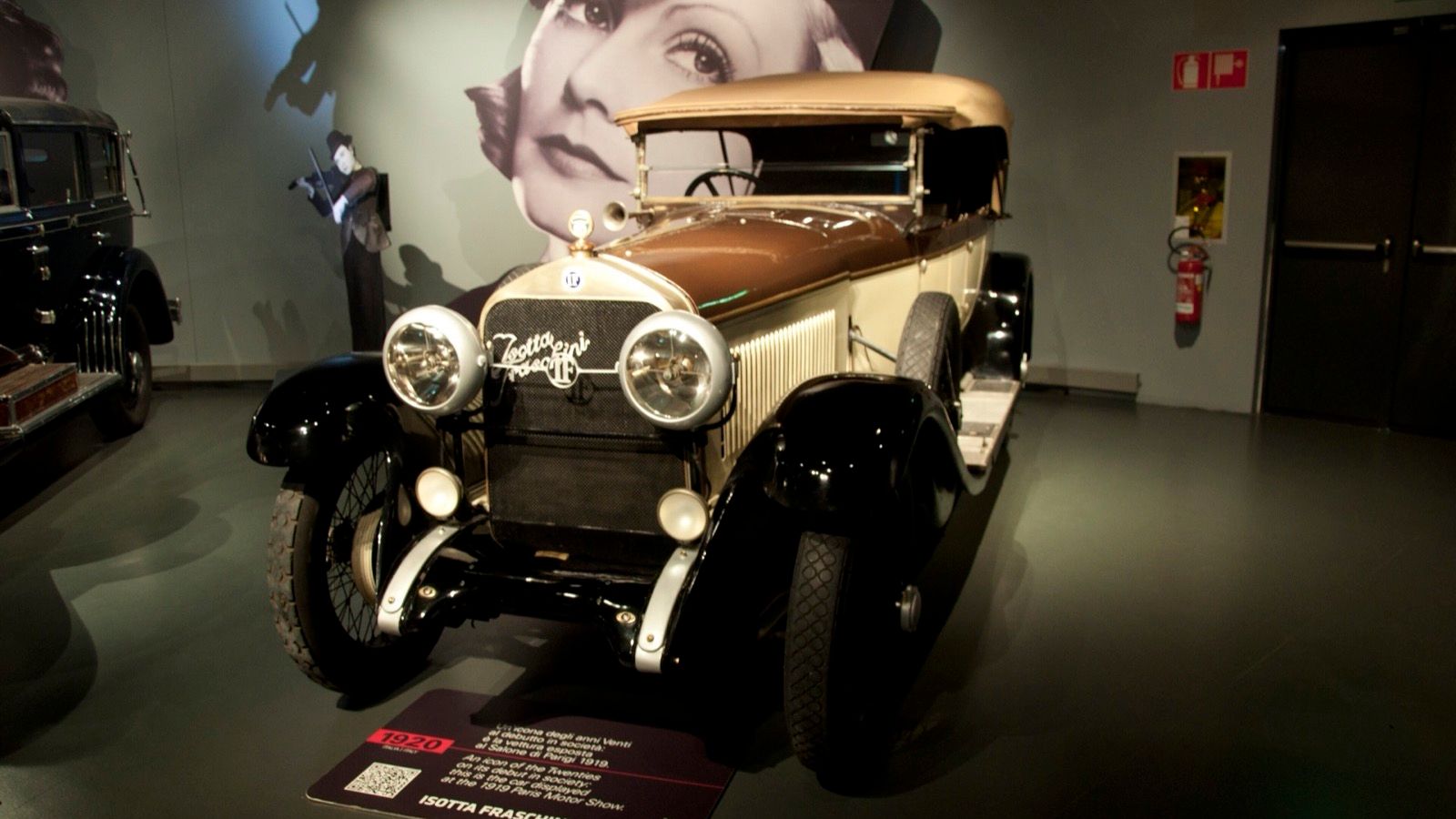
Isotta Fraschini Tipo 8 History
The world's first series-production straight-eight automobile — a landmark 5.9-litre chassis supplied bare for coachbuilt bodywork.
Photo: “1920 Isotta Fraschini Tipo 8 Museo Nazionale dell'Automobile Torino 01” by Rahil Rupawala / Wikimedia Commons, licensed under CC BY 2.0. Cropped to 16:9.
History
Developed in the final years of World War I and unveiled at the 1919 Paris Salon, the Tipo 8 was a deliberate one-model policy by Isotta Fraschini, staking the company's identity on a single magnificent machine. Its 5.9-litre overhead-valve straight-eight — running on a nine-bearing crankshaft with an alloy cylinder block — produced around 80 bhp at 2,200 rpm and was the first such engine ever fitted to a production automobile.
Like the Rolls-Royce Silver Ghost, the Tipo 8 was sold exclusively as a rolling chassis; bodies were commissioned from Italy's finest coachbuilders — principally Carrozzeria Castagna and Cesare Sala — as well as from American and other European firms. Approximately 320 chassis were built, roughly one third of which were exported to the United States, reflecting the car's immediate appeal to the new American wealthy class of the 1920s.
The Tipo 8's four-wheel brakes, pioneered by Isotta Fraschini as early as 1909 on competition cars and standardised by 1910 on their road models, were years ahead of most rivals. The car's combination of technical modernity and coachbuilt elegance set the template for the larger-engined Tipo 8A that followed.
Generations
First generation · Tipo 8 original
Photo: “1920 Isotta Fraschini Tipo 8 Museo Nazionale dell'Automobile Torino 01” by Rahil Rupawala / Wikimedia Commons, licensed under CC BY 2.0. Cropped to 16:9.
5.9-litre OHV straight-eight on a single chassis series; ~320 built, one-third exported to the US.
1920 Photo: “1920 Isotta Fraschini Tipo 8 Museo Nazionale dell'Automobile Torino 01” by Rahil Rupawala / Wikimedia Commons, licensed under CC BY 2.0. Cropped to 16:9.
Body styles
- Coachbuilt (open tourer, landaulet, limousine, roadster)
Related models
Collect the nameplate
Find a scale model of the Isotta Fraschini Tipo 8
Search Amazon across available years, colors, and scales. Exact releases vary, so confirm the listing before ordering.