
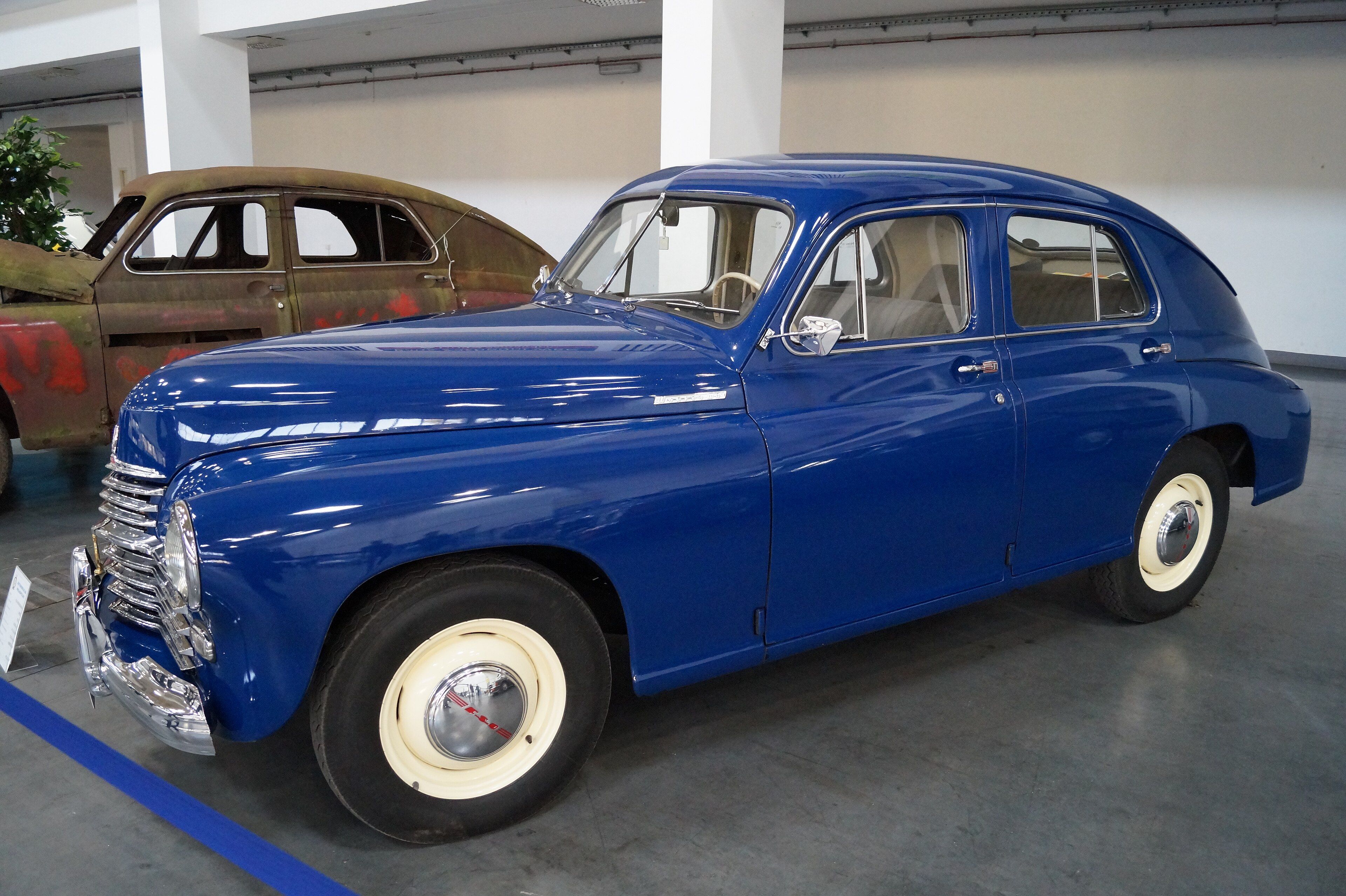
FSO Warszawa History
Poland's first postwar mass-produced car — a Soviet Pobeda-based saloon, built 1951–1973 in 254,471 units.
Photo: “File:FSO Warszawa M20 (MSP15).JPG” by Jakub "Flyz1" Maciejewski / Wikimedia Commons, licensed under CC BY-SA 3.0
History
The Warszawa (Polish for 'Warsaw') was the first mass-produced passenger car built in Poland after World War II, rolling off the new Żerań factory line on 6 November 1951 under a Soviet licence for the GAZ-M20 Pobeda. Early cars were identical to the Soviet original, powered by a 2.1-litre side-valve four producing 50 hp.
Through the late 1950s and 1960s FSO continuously improved the Warszawa — the 201/202 models (1960–1962) introduced over 200 technical changes, and from 1962 an OHV engine option brought 70 hp. The final 223/224 series adopted a three-box body; model numbers were renumbered in 1968 to avoid a clash with Peugeot's naming conventions.
Beyond the core saloon, FSO developed pickup, station wagon, and commercial van derivatives. The Warszawa platform also underpinned the long-lived Żuk and Nysa light commercial vehicles. Production of the passenger car ended in 1973 as the Polski Fiat 125p displaced it; total output reached 254,471 units.
Generations
First generation (M20 Pobeda licence) · M20
Photo: “File:FSO Warszawa M20 (MSP15).JPG” by Jakub "Flyz1" Maciejewski / Wikimedia Commons, licensed under CC BY-SA 3.0
Identical to the Soviet GAZ-M20 Pobeda — side-valve 2.1 L, 50 hp; the foundation of Polish postwar motoring.
Second generation (201/202) · 201/202
Modernised with 200 technical improvements; OHV 70 hp option added from 1962.
Third generation (223/224) · 223/224
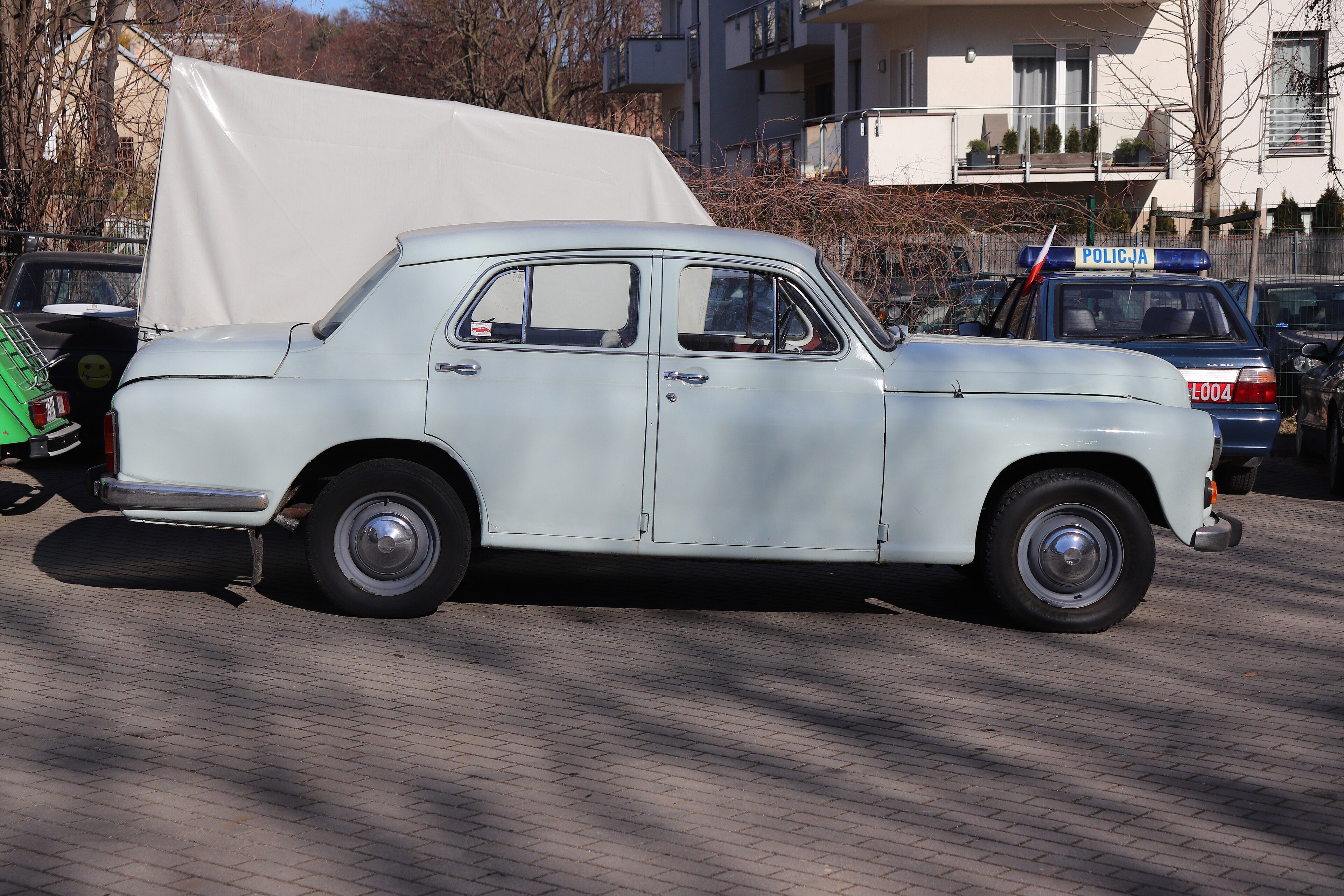
Photo: “File:Gdansk Warszawa 223 1.jpg” by Andrzej Otrębski / Wikimedia Commons, licensed under CC BY-SA 4.0
Three-box body; renumbered 223/224 after 1968 to avoid Peugeot trademark conflict.
Body styles
- Sedan
- Station wagon
- Pickup
- Van
Related models
Collect the nameplate
Find a scale model of the FSO Warszawa
Search Amazon across available years, colors, and scales. Exact releases vary, so confirm the listing before ordering.