
First generation · Original / classic · 1964–1973
1964Ford Mustang
The original pony car. Launched April 1964 (the famous “1964½” cars, titled as 1965s) and produced through 1973.
First generation · Original / classic“1964½” launch year
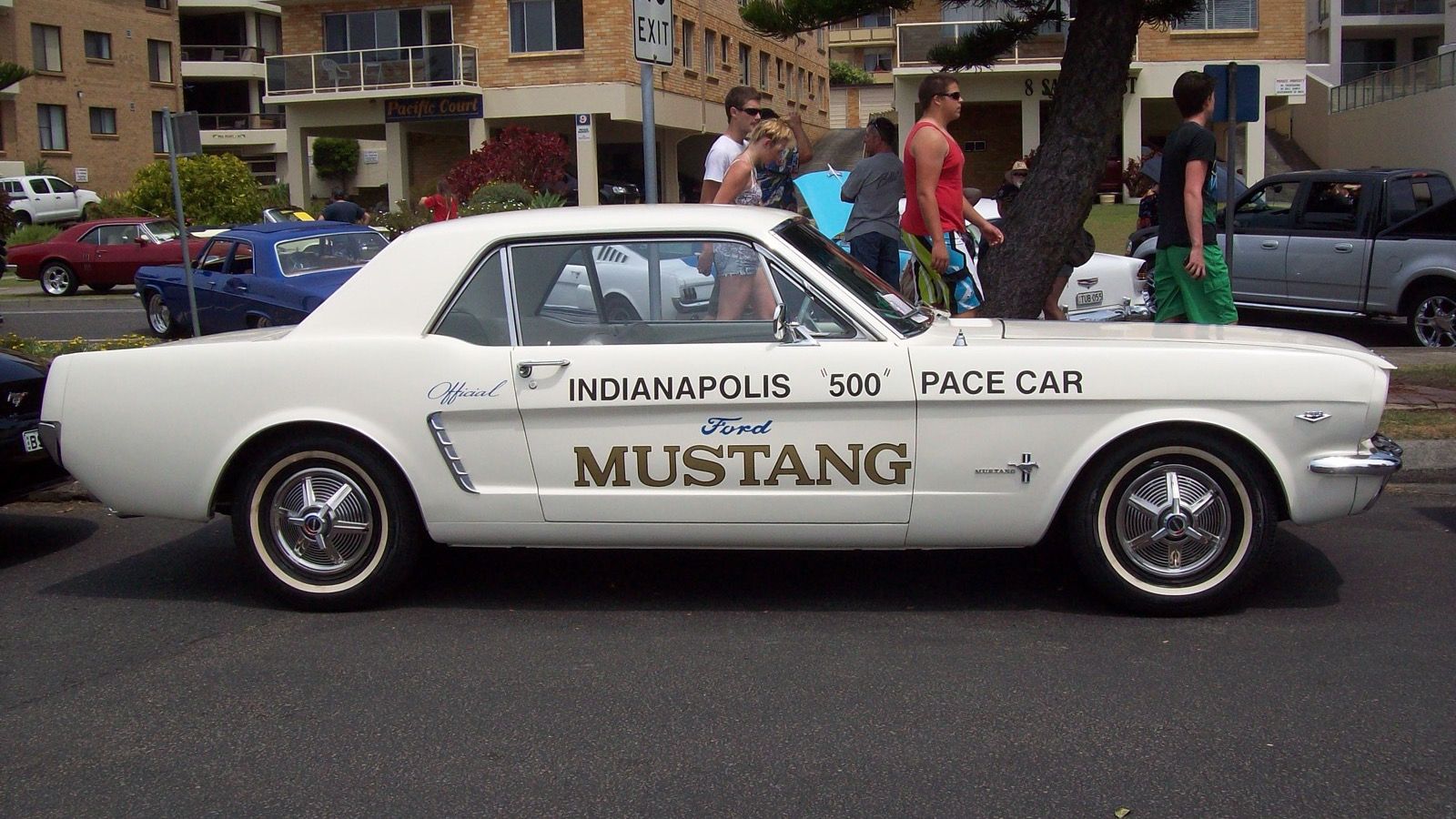
Photo: “1964 Ford Mustang (15364728796).jpg” by James Banks Photography / Wikimedia Commons, licensed under CC BY-SA 2.0. Cropped to 16:9.
Quick facts
- Engines
- 3offered170 I6 → 289 4-bbl "D-code" (early-only, ~210 hp)
- Top output
- 210hp289 4-bbl "D-code" (early-only, ~210 hp)
- Production
- ~121,538 early cars
- Base price
- $2,368hardtop, 170 six
- Today
- ≈$24,000inflation-adjusted MSRP, not market value
Body stylesHardtop · Convertible
Start here
What do you need to know?
This page covers the whole 1964 Ford Mustang model year. Choose your task first; exact trims and engines are separated where the factory offered different versions.
Documented lineup
Find your exact 1964 Mustang
Start with a family, body style, or engine. Every card opens the facts and maintenance information for that factory version.
Exact factory pairings documentedHow this lineup was verified
These source-backed records identify published body, engine, and transmission combinations. Exact pairings do not by themselves assert that every factory option or special edition is represented.
No factory configuration matches those filters.
The 1964 model year
Overview
The Mustang launched at the New York World’s Fair on April 17, 1964, with the earliest cars built from March 1964. Enthusiasts call these first cars “1964½” — Ford titled and VIN’d them all as 1965 models, but they are mechanically distinct from the cars built after the August 1964 changeover. First-week orders exceeded 22,000.
Specifications
- Engines
- 170 I6
- 260 V8 (~164 hp, dropped for regular '65)164 hp
- 289 4-bbl "D-code" (early-only, ~210 hp)210 hp
- Transmissions
- 3-speed manual, 4-speed manual, 3-speed automatic
- Body styles
- Hardtop, Convertible
- Base price
- $2,368 (hardtop, 170 six)See what that's worth today →
- Production
- ~121,538 early cars
Year over year
What changed
- Launch year — the defining early features set these cars apart from the regular 1965s.
- DC generator (later replaced by the alternator at the August 1964 changeover).
- 170 six and 260 V8 were both retired for the regular 1965 model year.
- The 289 "D-code" 4-bbl was an early-only engine.
Worth knowing
Notable
- Early-production cachet — the generator, early engines, and D-code 289 mark a genuine 1964½ car.
- Originality and matching-numbers drive value; there are no fixed dollar values for these cars.
Living with it
Reliability & ownership notes
- Early cars use a ~35A DC generator vs the early alternator (~45A) that replaced it — many owners convert to an alternator.
- Generation-wide unibody rust is the chief concern: floor pans, cowl, and shock towers.
Before you buy
Buyer's checklist
What to physically go and look at on a 1964 car, worst first, and what a bad result actually means. 6 of these are walk-away-or-price-for-it items.
- CriticalStructural or safety. Walk away, or price for a full repair.
- MajorExpensive, but bounded and known.
- ModerateNormal wear on a car of this age.
Rust & structure
The unibody has no separate frame, so structural corrosion is a repair bill rather than a cosmetic one. Work down this list before you look at anything else.
Cowl / plenum (under the windscreen)Critical
The classic first-generation killer. The cowl vent drains block with leaves, water sits in the plenum, and it rots from the inside out — invisible from above. Run a hose into the cowl vents with the doors open and watch the footwells and the kick panels. Wet carpet after rain, or a heater that smells damp, is the tell.
Repairing a rotten cowl means removing the windscreen and cutting the top off the plenum. It is one of the most expensive rust jobs on the car and it is routinely hidden by a fresh carpet set.
Torque boxesCritical
Structural boxes tying the floor to the frame rails, behind the front wheels and ahead of the rear wheels. Convertibles have extra ones and rely on them completely. Get underneath and prod them. Doors that drop, or that need lifting to latch, point straight here.
Convertibles have no roof structure, so rotten torque boxes let the whole shell flex. Treat this as structural on any open car.
Front shock towersCritical
Check around the upper shock mount and where the tower meets the inner apron, on both sides. Cracks and rust here change the front suspension geometry and are a safety issue, not a cosmetic one.
Rear frame rails and spring perchesCritical
Follow the rails from the torque boxes back over the axle. Rot at the leaf-spring front hangers is both common and structural.
Floor pans and toe boardsMajor
Lift the carpet — all of it, both sides, front and rear — and look from underneath as well. Patches welded over patches are common. Fresh underseal on an older car is often there to hide something.
Rear quarter panels and wheel archesMajor
The most visible rust and the most frequently bodged. Check inside the boot, the drop-offs either side of the boot floor, and behind the rear wheels. A magnet finds filler; a torch inside the boot finds daylight.
Boot (trunk) floor and drop-offsMajor
Lift the mat and the spare. Water enters past perished rear window and boot seals and collects here. The drop-off panels either side are a known rot point and are structural on convertibles.
Lower doors, front fender bottoms and rear valanceModerate
Drain holes clog and the panels rot from inside. These are bolt-on or readily available panels, so they are the least alarming rust on the list — but they signal how the car has been stored.
Mechanical, electrical & paperwork
Everything a running, driving car should be checked for — and the identity checks that decide what the car is actually worth.
Panel gaps and door fitCritical
Stand back and look down each side. Uneven gaps, a door that drops on opening, or a bonnet that sits proud usually mean structural rust or an old accident — not a bad panel fit from the factory.
VIN, door data plate and paperwork agreementCritical
Check that the VIN, the door data plate and the title agree with each other and with what the car actually is. A car sold as a GT, a K-code or a Pony-interior car should be verifiable from its codes — and codes can be, and are, faked.
Codes record what Ford built, not what is in front of you now. For a car with a significant price premium riding on its identity, get a marque registry or a specialist to look before you pay for the badge.
BrakesMajor
Four-wheel drums were standard; front discs were optional on V8 cars. Establish which the car actually has before buying parts — and expect drum-braked stopping distances if it has drums.
Charging and wiringMajor
Original harnesses are sixty years old. Look for added inline fuses, spliced repairs and aftermarket accessories wired straight to the battery — a genuine fire risk on a car with fabric-loom wiring.
Fuel system after long storageMajor
Tanks rust internally and modern ethanol-blended fuel attacks period rubber. A car that has stood for years usually needs the tank, lines and flexible hoses done before it is safe to drive far.
Convertible top, frame and sealsMajor
On an open car, check the frame for rust and the mechanism for operation under its own power, plus the rear window and the seals. Also confirm the extra convertible bracing underneath is present and sound.
Evidence over descriptionMajor
Ask for receipts, photographs of the car mid-restoration, and a look at it on a lift. A seller who can show the bodywork before the paint went on is telling you more than any description.
Engine — 200 six / 289 V8Moderate
Both are tough, simple and superbly supported by the parts industry. Look for oil pressure once warm, smoke on the overrun (valve seals) or under load (rings), and coolant in the oil. A tired one is a known-cost rebuild rather than a deal-breaker.
Front suspension and steeringModerate
Upper and lower ball joints, idler arm and the steering box all wear. Excessive play at the wheel and a wandering front end are normal for a neglected car and are a well-trodden, affordable rebuild.
Cooling systemModerate
These engines are not prone to overheating when healthy. A car that runs hot in traffic normally has a silted radiator, a tired water pump or a missing fan shroud — check the shroud is actually there.
Interior trim and glassModerate
Reproduction upholstery, carpet and weatherstrip are cheap and excellent. Correct original trim, date-coded glass and undamaged dash pads are not — and they are what separates a good car from an average one.
Non-original drivetrainModerate
Engine swaps, later five-speeds and disc-brake conversions are extremely common. None is a fault — a modified car can be the better driver — but it materially changes value, so establish what is actually fitted rather than what the advert says.
A where-to-look guide, not a repair estimate. A where-to-look guide for the 1964½–1973 unibody shell, worst-first. Deliberately carries no repair prices: costs vary far too much by region, shop and severity for a figure here to be honest. Rust is the deciding factor on these cars — mechanical parts are cheap and available, structural steel and the labour to fit it are not. Have any car you are serious about inspected on a lift. Nothing here replaces putting the car on a lift with someone who knows the model.
Sources: Hagerty Media — 1965–66 Ford Mustang buyer's guideWikipedia — "Ford Mustang (first generation)"
What it costs now
Price today
Current market value
We don't publish a market estimate for the 1964 model year yet. A valuation ships here only when it can be sourced and dated — we'd rather show nothing than a number we can't stand behind.
Original MSRP adjusted for inflation (CPI, 2024); not the car's current market/collector value. Source: U.S. Bureau of Labor Statistics, CPI-U (U.S. city average, all items), annual average.
Maintenance & service parts
Keep your 1964 Mustang on the road
Start with the service interval, then match the engine or exact version you own. Order links appear only when a catalog-backed part number is available, and every listing still needs a fitment check.
Service desk
What this car needs & when
Use this as a service-planning checklist for 1964 Ford Mustang. Start with the interval, confirm which engine or configuration you have, then use an exact ordering reference when one is verified.
- Service topics
- 12
- Factory intervals
- 5
- Fitment-scoped
- 6
- Exact references
- 1
Before orderingIdentify your engine, options and build date.Part numbers and sizes can change within one model year. Shopping links appear only for catalog-backed references; still verify the listing against your vehicle before ordering.
Engine oil filter
Exact reference available
Manufacturer application-catalog fitment only; this does not establish an oil-change interval.
170 cu in inline-six
Baldwin B2
Source: Baldwin Filters — Automotive Applications catalog (2017) · Pre-1980 Applications section — Ford 1964, Mustang 170 cu in inline-six row · checked
Verified ordering references
- Service replacementBaldwin B2
Qty. 1 · Engine oil filter · catalog-listed
Baldwin's manufacturer application table lists this filter for the stated model year and engine. Confirm the VIN and installed engine before ordering.
Catalog: Baldwin Filters — Automotive Applications catalog (2017) · Pre-1980 Applications section — Ford 1964, Mustang 170 cu in inline-six row · checked
Search this part on Amazon
Engine oil and filter
Sourced interval available
Source: Ford — 1964½ Mustang launch brochure maintenance summary · Back page, Mustang Specifications: Engine Features and Twice-a-Year Maintenance · checked
Replaceable dry air-cleaner element
Sourced interval available
Source: Ford — 1964½ Mustang launch brochure maintenance summary · Back page, Mustang Specifications: Engine Features and Twice-a-Year Maintenance · checked
Spark plugs
Fitment must be confirmed
Heat range and gap are engine-specific across this generation — follow the tune-up chart for your model year and engine.
PCV valve
Fitment must be confirmed
Valve and grommet differ by engine. Match to the engine actually in the car.
Disposable fuel filter
Sourced interval available
Source: Ford — 1964½ Mustang launch brochure maintenance summary · Back page, Mustang Specifications: Engine Features and Twice-a-Year Maintenance · checked
Drive belts
Fitment must be confirmed
V-belt count and length depend on engine and options (power steering, air conditioning, alternator). Measure the belts on the car.
Engine coolant / antifreeze — replace
Sourced interval available
Source: Ford — 1964½ Mustang launch brochure maintenance summary · Back page, Mustang Specifications: Engine Features and Twice-a-Year Maintenance · checked
Brake pads & shoes
Fitment must be confirmed
Drums were standard on early cars with front discs optional on V8s; later years differ. Order to match what is fitted, not to the model year.
Wiper blades
Fitment must be confirmed
Blade length and arm fitting vary through the generation — measure the blades on the car; an adapter may be needed for a modern blade.
Battery
Fitment must be confirmed
12-volt. Group size fitted today varies by car — check tray and cable clearance. Modern equivalence, not a factory specification.
Minor chassis lubrication
Sourced interval available
Source: Ford — 1964½ Mustang launch brochure maintenance summary · Back page, Mustang Specifications: Engine Features and Twice-a-Year Maintenance · checked
Major chassis lubrication
Source: Ford — 1964½ Mustang launch brochure maintenance summary · Back page, Mustang Specifications: Engine Features and Twice-a-Year Maintenance · checked
Collect
Bring this model year home
Find a scale model using the exact year, make, and model—not a generic generation search.
Sources
- Wikipedia — "Ford Mustang (first generation)"
- FordMuscle — "The Mythical 1964½ Mustang"
- Vintage Mustang Forums / CJ Pony Parts
- HotCars
- Speedway Motors
- Gilmore Car Museum
Other First generation years
Explore the Original / classic generation →All First generation · Original / classic years →