
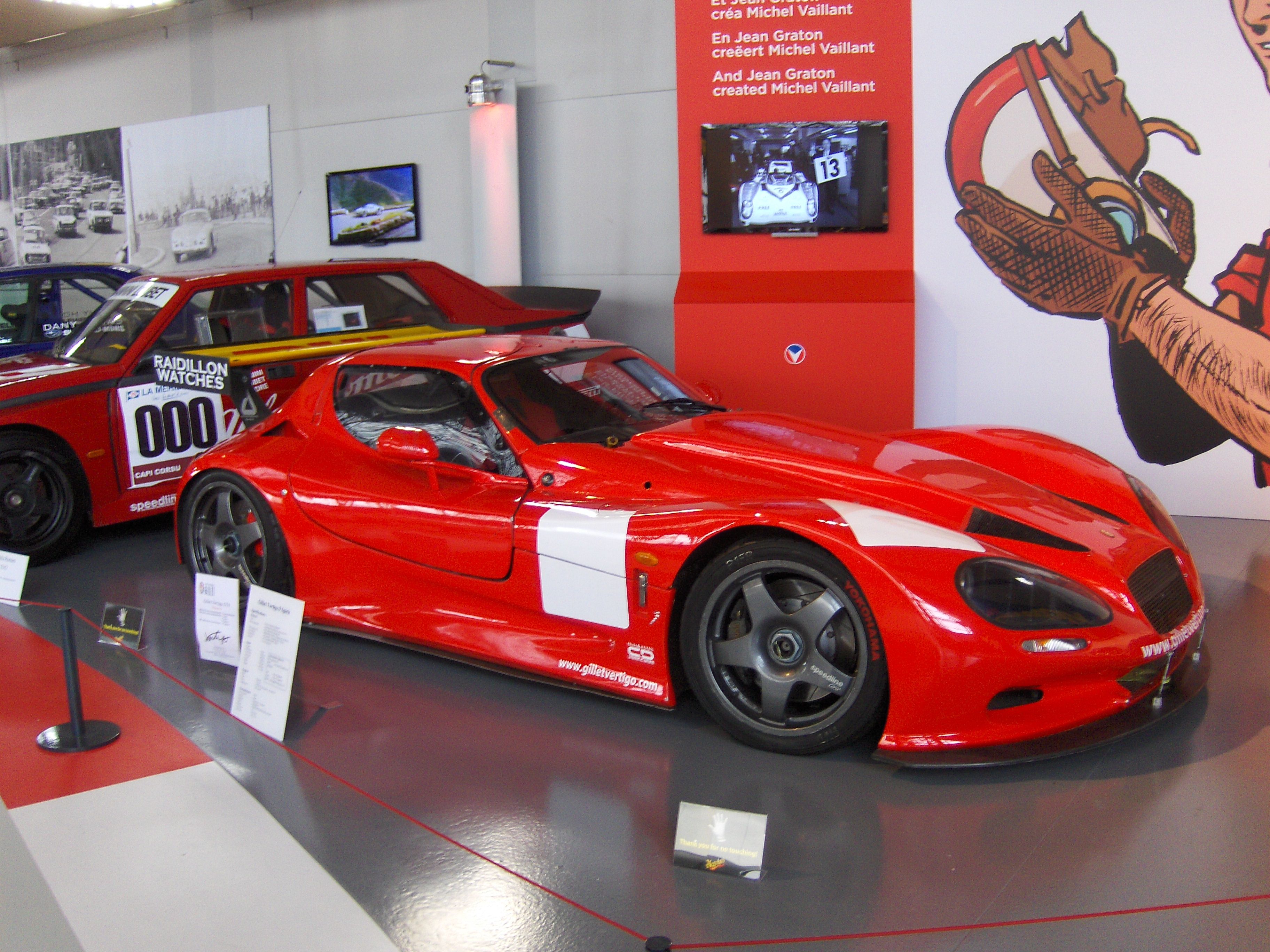
Gillet Vertigo History
Gillet's sole model and raison d'être — an ultra-lightweight, carbon-fiber mid-engine two-seater built in tiny numbers since 1992.
Photo: “Gillet Vertigo Streiff en Autoworld Brussels, 2013.jpg” by Schumi4ever / Wikimedia Commons, licensed under CC BY-SA 3.0
History
Tony Gillet, a former racing driver and Belgian hill-climb champion (1979–1980), designed the first Vertigo prototype in 1991 and unveiled it at the 71st Brussels Auto Show in January 1992. The car's defining characteristic was its monocoque chassis of carbon fiber and Nomex honeycomb — technology borrowed directly from Formula One — which kept the complete car below 1,000 kg and gave it structural rigidity far beyond its price class. The initial road car used a Ford Cosworth 2.0-litre four-cylinder, later replaced by a 3.0-litre Alfa Romeo V6; in 1994 the Vertigo entered the Guinness Book of Records for accelerating from 0 to 100 km/h in 3.266 seconds.
A significant update arrived with the Vertigo Streiff, named in tribute to Formula One driver Philippe Streiff. The wider-bodied Streiff was homologated for FIA GT competition and competed in the Belcar Belgian GT Championship from 1998 onward, accumulating three FIA GT Championship G2 class titles (2006, 2007, 2008). A civilian version of the Streiff was offered in a limited run of 25 units at approximately €103,000 each, powered by a 3.6-litre Alfa Romeo V6 producing around 360 PS.
The Vertigo.5 Spirit, introduced around 2010, represented the most thorough redesign in the model's history. It adopted a 4.2-litre Ferrari/Maserati V8 producing approximately 420 hp and established the car as a genuine six-figure supercar (list price approximately €260,000). The chassis was also supplied to Zagato, who built the one-off Zagato Maserati Mostro on it in 2015. In 2018 Gillet returned to motorsport at Pikes Peak with a flax-fiber–bodied racing Vertigo driven by Vanina Ickx, daughter of six-time Le Mans winner Jacky Ickx.
Generations
First generation · Vertigo Mk1
Original carbon-chassis road car; Ford Cosworth four-cylinder then Alfa Romeo 3.0 V6; 1994 Guinness record holder for 0–100 km/h acceleration.
Second generation · Vertigo Streiff
Photo: “Gillet Vertigo Streiff en Autoworld Brussels, 2013.jpg” by Schumi4ever / Wikimedia Commons, licensed under CC BY-SA 3.0
Wider, FIA GT-homologated evolution; Alfa Romeo 3.6 V6 (360 PS); only ~25 road cars built; three FIA GT G2 class championships (2006–2008).
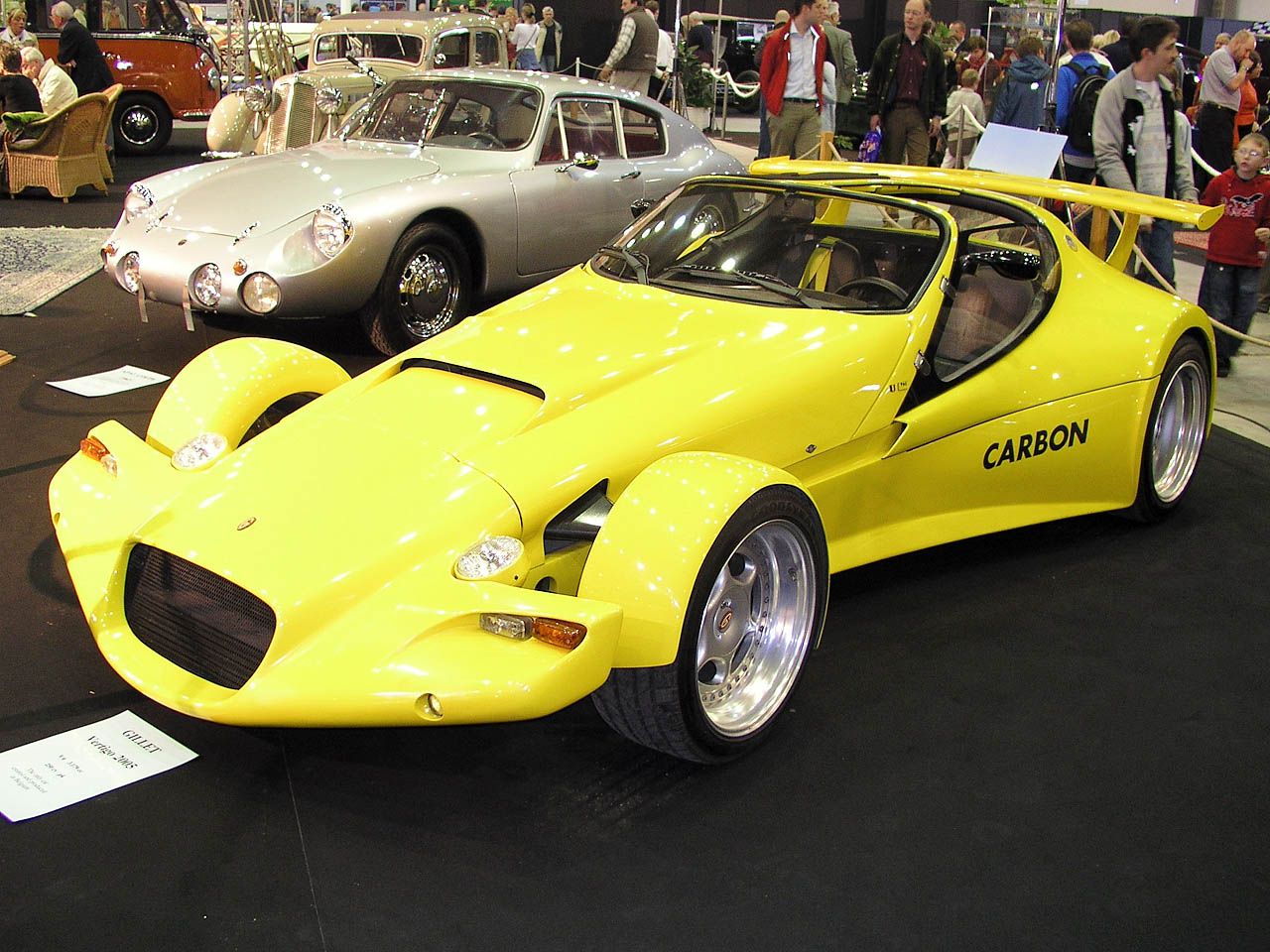
2005 Photo: “2005 Gillet Vertigo fl3q.JPG” by André Ritzinger / Wikimedia Commons, licensed under CC BY 3.0
Third generation · Vertigo.5 Spirit
Most extensive redesign; 4.2-litre Ferrari/Maserati V8 (~420 hp); basis for the Zagato Maserati Mostro show car (2015).
Body styles
- Coupe
Notable special editions & performance variants
Vertigo Streiff (road car)
Limited run of ~25 civilian units at ~€103,000 each, named for F1 driver Philippe Streiff.
Pikes Peak racer
One-off hillclimb car with flax-fiber bodywork driven by Vanina Ickx at the 2018 Pikes Peak International Hill Climb.
Related models
Collect the nameplate
Find a scale model of the Gillet Vertigo
Search Amazon across available years, colors, and scales. Exact releases vary, so confirm the listing before ordering.