
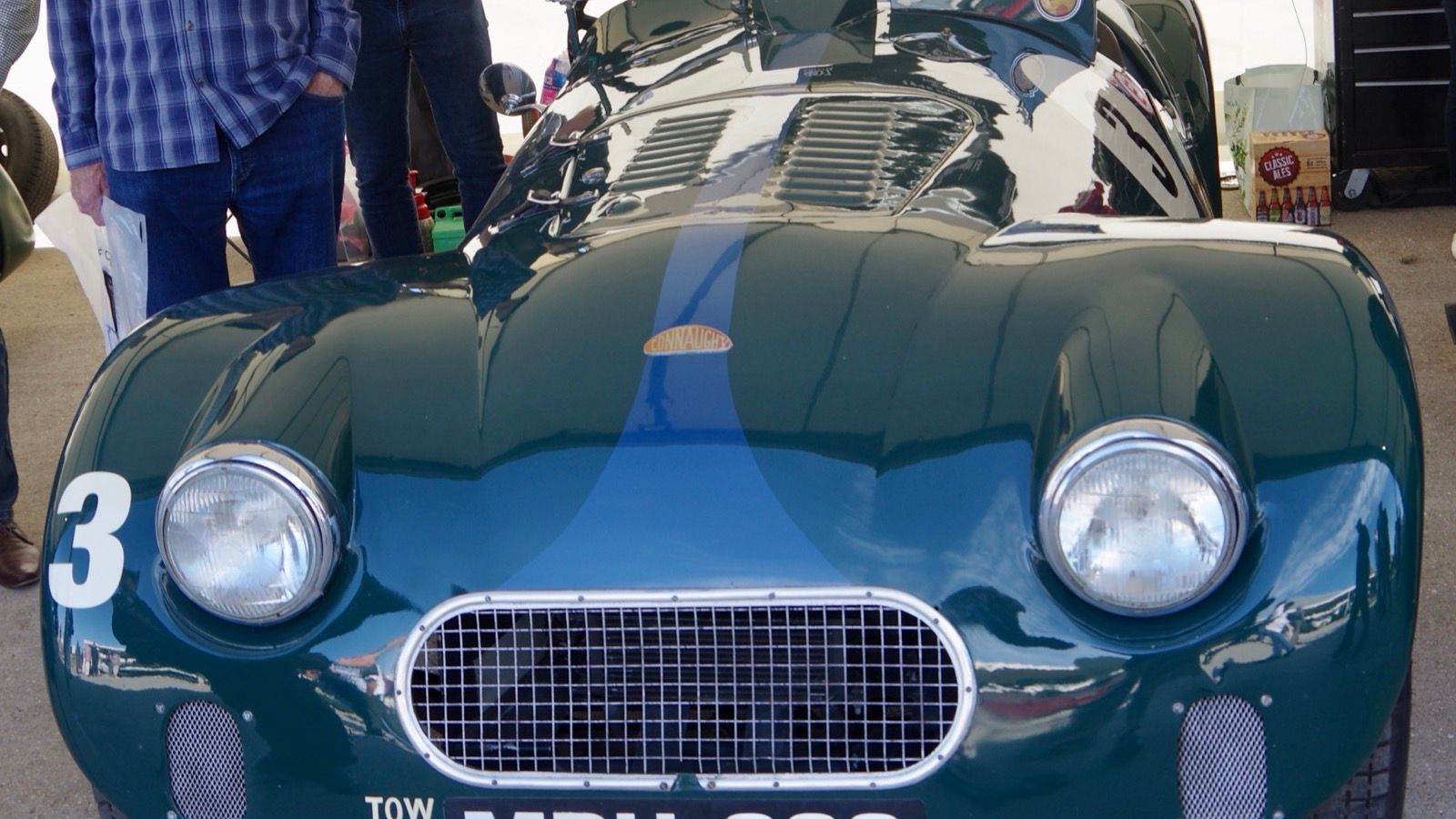
Connaught L Series History
Connaught's tiny run of aluminium-bodied road sports cars — just 14 built across the L2 and L3 variants on a Lea-Francis chassis.
Photo: “1948 Connaught L2 (31467232198)” by David Merrett / Wikimedia Commons, licensed under CC BY 2.0. Cropped to 16:9.
History
The L Series was Connaught's initial foray into production road cars, built on Lea-Francis sports chassis and bodied in aluminium by Leacroft of Egham. The first type sold was the L2, fitted with the Lea-Francis 1,767cc overhead-valve four-cylinder engine tuned to approximately 122 bhp — the less powerful L1 spec found no buyers. Eleven L2s were built.
When Lea-Francis updated its chassis in 1949 to add torsion-bar independent front suspension, the designation changed to L3. Three L3s were produced, one of which was the stark L3/SR (Sports Racer), a cycle-winged competition variant. Production of the L series ended in 1953 as Connaught focused its resources on single-seater racing cars.
Only 14 L-series cars were built in total — some of the rarest British sports cars of the early 1950s. Their aluminium bodies, Lea-Francis-derived engines, and competition-derived suspension made them formidable in club racing and hill climbs as well as on the road.
Generations
L2 · Connaught L2
Photo: “1948 Connaught L2 (31467232198)” by David Merrett / Wikimedia Commons, licensed under CC BY 2.0. Cropped to 16:9.
Eleven built on the original Lea-Francis chassis; 1,767cc four-cylinder tuned to ~122 bhp, bodied in aluminium by Leacroft of Egham. (Sources vary on the exact L2-to-L3 cut-over year, the transition following Lea-Francis's 1949 chassis update.)
L3 / L3 SR · Connaught L3
Three built on the updated chassis with torsion-bar independent front suspension; the L3/SR variant was a stark cycle-winged sports racer.
Body styles
- Two-seat roadster
Related models
Collect the nameplate
Find a scale model of the Connaught L Series
Search Amazon across available years, colors, and scales. Exact releases vary, so confirm the listing before ordering.