
2015 Golf: TSI, TDI, GTI, R and e-Golf explained
Compare the 2015 U.S. Golf’s gasoline, diesel and electric drivetrains, GTI Performance Package and Golf R suspension using period VW sources.
Answer first
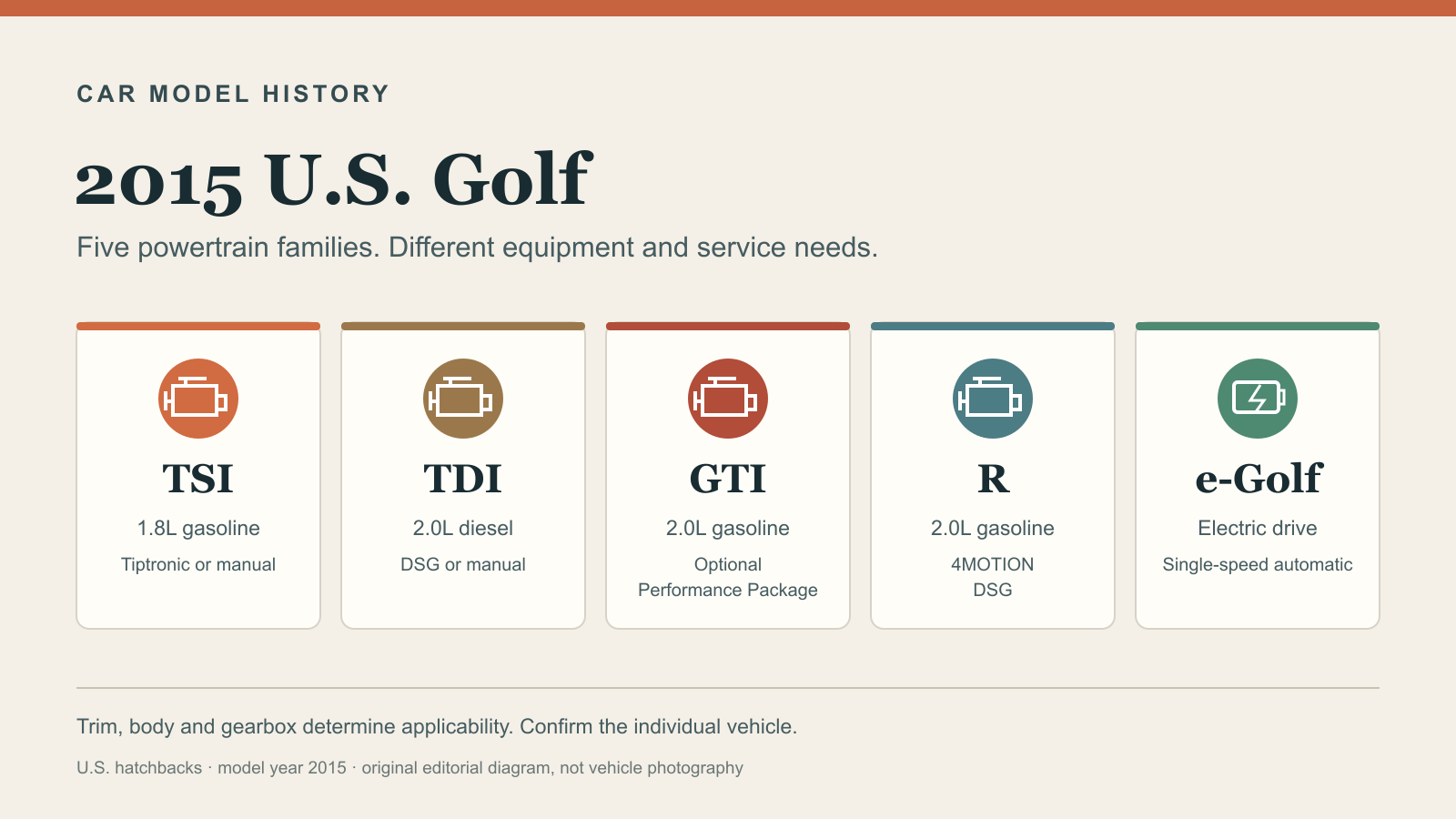
The TSI and TDI use different automatic transmissions, the GTI Performance Package changes brakes and differential hardware, and the R adds all-wheel drive. The e-Golf follows a separate electric service schedule.
Five ways to drive a 2015 Golf
The 2015 USA Golf family offered more than a choice of engines. The gasoline TSI and diesel TDI used different automatic transmissions. The GTI Performance Package changed braking and front differential hardware. The R combined its own engine specification with all-wheel drive, while the e-Golf replaced combustion power with an electric motor.
Those differences change what you compare on an actual car: the gearbox fitted, how power reaches the road, the suspension equipment and the service tasks that follow. This guide covers USA hatchbacks, with the Golf SportWagen treated as a separate body line. Period brochures, sales documents and service schedules establish the boundaries.
TSI and TDI: the transmission label matters
Volkswagen’s USA Golf brochure separates the 1.8-liter turbocharged gasoline TSI from the 2.0-liter turbocharged diesel TDI. Their automatic choices also differ: the gasoline line uses a six-speed automatic with Tiptronic, while the diesel offers a six-speed DSG alongside its manual option. Calling both simply “automatic” hides a distinction that matters when reading service information.
Trim and door count add another boundary. The February 2015 order guide identifies a four-door TSI S automatic separately from a four-door S with Sunroof manual. The latter carries sales code AU14Q1. A manual transmission attached to the plain four-door S name would describe the wrong combination, even though each individual word sounds plausible.
GTI Performance Package: more than an output figure
The GTI brochure lists 210 horsepower for the standard 2.0-liter turbocharged engine and 220 with the Performance Package. The package also brings larger brakes and a VAQ front differential lock. A comparison based only on the extra ten horsepower misses the braking and traction hardware that distinguishes the package on the car.
Dynamic Chassis Control has a narrower scope. The brochure limits that option to SE and Autobahn versions equipped with the Performance Package. A GTI S with the package does not acquire DCC by association. When comparing two GTIs, check the package and optional suspension separately: matching engine output does not establish that both cars have the same chassis equipment.
Golf R: traction and suspension are separate questions
The USA 2015 R brochure describes a 292-horsepower 2.0-liter turbocharged engine, 4MOTION and a six-speed DSG. The February order guide separates the four-door R from the R with DCC and Navigation: sales codes 5G11S7 and 5G12S7. Both use DSG, but the latter combines adjustable suspension with additional equipment.
An R comparison therefore has two questions: which drivetrain does it use, and which suspension package does it carry? The same output and gearbox do not answer both. A broad VIN document contains a manual-transmission R code, but that alone does not establish a USA retail offering. For this model year and market, the final brochure and order guide specify DSG.
e-Golf: electric identity without invented trim details
The original USA e-Golf brochure describes SEL Premium with an 85-kW electric motor, a 24.2-kWh battery and a single-speed automatic. Those figures belong to that documented specification. They should not migrate automatically into every later trim merely because the vehicle retains the same name.
Limited Edition has a narrower but positive evidence chain. Volkswagen’s 2015 VIN filing explicitly identifies a four-door Limited Edition with an A1 automatic transmission code. A Bob Baker Volkswagen advertisement in the May 1, 2015 Rancho Santa Fe News independently offers a new Limited Edition four-door automatic. That supports the offered identity. This article leaves its battery, output, heating equipment and complete feature list unspecified.
The service schedule follows the hardware
The Golf TDI schedule calls for fuel-filter replacement every 20,000 miles and a timing-belt replacement at 130,000 miles. It treats the diesel particulate filter differently: inspect ash loading at 120,000 miles, then check again at 20,000-mile increments if replacement was unnecessary. An inspection threshold is not an automatic replacement instruction.
The revised GTI schedule adds front differential-lock fluid service every three years, if equipped. The R schedule separately specifies three-year Haldex oil service. Both identify 40,000-mile DSG fluid-and-filter milestones. These are different systems with different applicability; a single generic “performance Golf service” entry would erase useful information.
Calendar time and mileage answer different questions
Volkswagen’s original 2015 USA workshop schedule places the first oil-and-filter service at 10,000 miles or one year, whichever arrives first. Subsequent milestone entries again specify one year after the previous service. Mileage alone therefore does not fully describe the ordinary service clock.
The e-Golf card has its own tasks, including charging-cable and socket checks, high-voltage component inspections and cabin-filter replacement. A shared family name is no reason to attach gasoline oil changes or spark plugs to it. These historical schedules explain the separation of responsibilities; they are not instructions to open a high-voltage system or a substitute for a vehicle-specific service procedure.
What the period documents can establish
A useful comparison keeps each specification within its documented scope. A sales code can settle trim and transmission. A maintenance card can establish a service milestone. A dealer advertisement can show an actual offer without establishing every engineering detail. Read those sources together when identifying a particular car, rather than assuming that nearby trims share every component or feature.
The diesel information here describes Volkswagen’s period USA offering and published service documents. It establishes neither the present registration eligibility nor the current emissions or campaign status of an individual vehicle. For historical research, preserve the original specification; for an individual car, retain its own identification and later documentation alongside it.
Evidence ledger
Primary sources
Time-sensitive claims were checked against the sources below on October 23, 2026. The linked source controls.
- Volkswagen — preserved manufacturer document2015 USA Golf brochure
- Volkswagen — preserved manufacturer document2015 USA GTI brochure, specification page 8
- Volkswagen — preserved manufacturer document2015 USA R brochure
- Volkswagen — preserved manufacturer document2015 USA e-Golf brochure, SEL Premium
- Volkswagen — preserved manufacturer documentFebruary 13, 2015 CW07 Price and Order Guide, pages 2, 12–13
- Volkswagen — preserved manufacturer document2015 USA VIN filing, PDF pages 9–10
- Volkswagen — preserved manufacturer document2015 TDI USA maintenance card
- Volkswagen — preserved manufacturer documentRevised 2015 GTI USA maintenance card, October 2020
- Volkswagen — preserved manufacturer document2015 R USA maintenance card
- Volkswagen — preserved manufacturer document2015 e-Golf USA maintenance card
- Volkswagen — preserved manufacturer documentOriginal 2015 USA workshop maintenance schedule, printed 1–2
- Bob Baker Volkswagen advertisement / The Rancho Santa Fe NewsMay 1, 2015 new Limited Edition offer, PDF 23 / printed 24