
Gumpert Apollo History
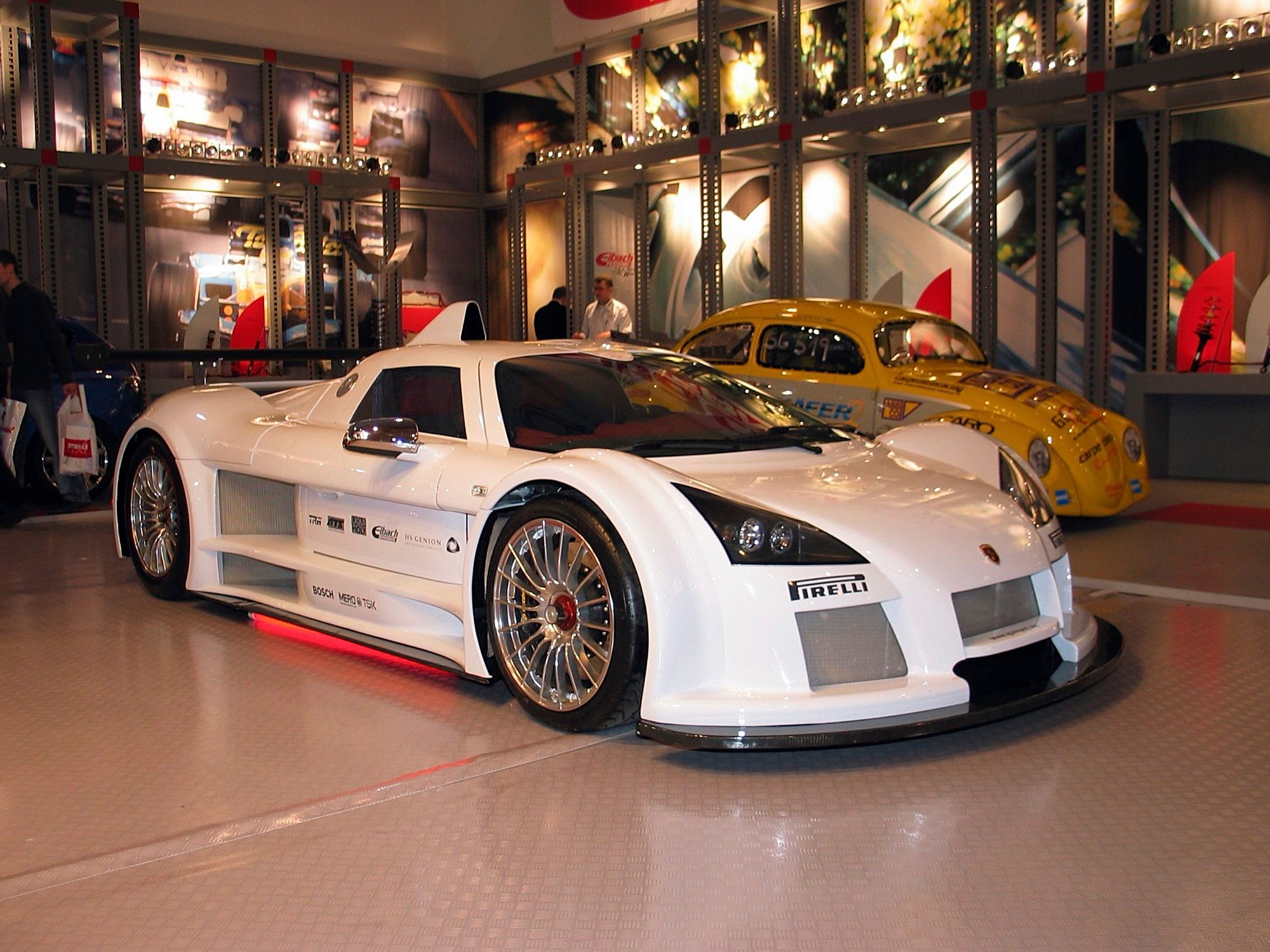
Gumpert's singular road-legal supercar — a mid-engine, twin-turbo V8 coupe with gullwing doors, capable of lapping the Nürburgring in 7:11.
Photo: “File:Gumpert Apollo (52470694616).jpg” by Thomas Vogt from Paderborn, Deutschland / Wikimedia Commons, licensed under CC BY 2.0
History
Production of the Apollo began in October 2005 at Gumpert's facility in Altenburg, Thuringia. The car was founded on a principle laid out by Roland Gumpert — former director of Audi Sport — when he first proposed the concept around 2000: it had to be fully street-legal yet instantly racetrack-ready. The chassis is a chromoly steel space frame with fibreglass or optional carbon-fibre body panels, with a quoted kerb weight of 1,100–1,200 kg depending on specification.
The Apollo's powerplant is a 4.2-litre (4,163 cc) twin-turbocharged version of Audi's V8, producing approximately 650 PS (478 kW) in base tune, 700 PS (515 kW) in Sport form, and 780–800 PS (574–588 kW) in Race specification. Drive goes to the rear wheels via a CIMA 6-speed sequential gearbox. The mid-engine layout, aggressive aerodynamics, and low weight gave the car genuine downforce — enough, in principle, to drive inverted in a tunnel at sufficient speed, as Gumpert famously claimed.
The Apollo's performance credentials were validated at the Nürburgring Nordschleife, where German magazine Sport Auto recorded a lap time of 7:11.57 — placing it among the fastest road-legal production cars of its era. On Series 11 of Top Gear, the car turned a 1:17.1 lap at the Dunsfold test track, setting a record that stood for two years until the Bugatti Veyron Super Sport eclipsed it. Only 44 units were produced across the model's 2005–2012 run before Gumpert filed for bankruptcy in August 2013.
Generations
First (and only) generation · Apollo
Photo: “File:Gumpert Apollo (52470694616).jpg” by Thomas Vogt from Paderborn, Deutschland / Wikimedia Commons, licensed under CC BY 2.0
Mid-engine, road-legal track car on a chromoly steel spaceframe with fibreglass or optional carbon panels; 4.2-litre twin-turbo Audi V8 in 650–800 PS tunes driving the rear wheels through a 6-speed sequential gearbox. 44 built over 2005–2012.

2008 Photo: “File:Goodwood FOS 2008 (2661943172).jpg” by Mark Woodbury from London, England / Wikimedia Commons, licensed under CC BY 2.0
Body styles
- Coupe
Notable special editions & performance variants
Apollo Sport
Mid-tier variant with approximately 700 PS; lighter specification targeting circuit use.
Apollo Speed
High-speed-focused variant unveiled at the March 2009 Geneva Motor Show, with roughly 800 PS and drag- and weight-reducing revisions aimed at top-speed clientele.
Apollo Race
Full-race tune at approximately 800 PS; stripped interior, slick-tyre ready.
Apollo Enraged
Limited final-run special with 780 PS and revised aerodynamic bodywork.
Related models
Collect the nameplate
Find a scale model of the Gumpert Apollo
Search Amazon across available years, colors, and scales. Exact releases vary, so confirm the listing before ordering.