
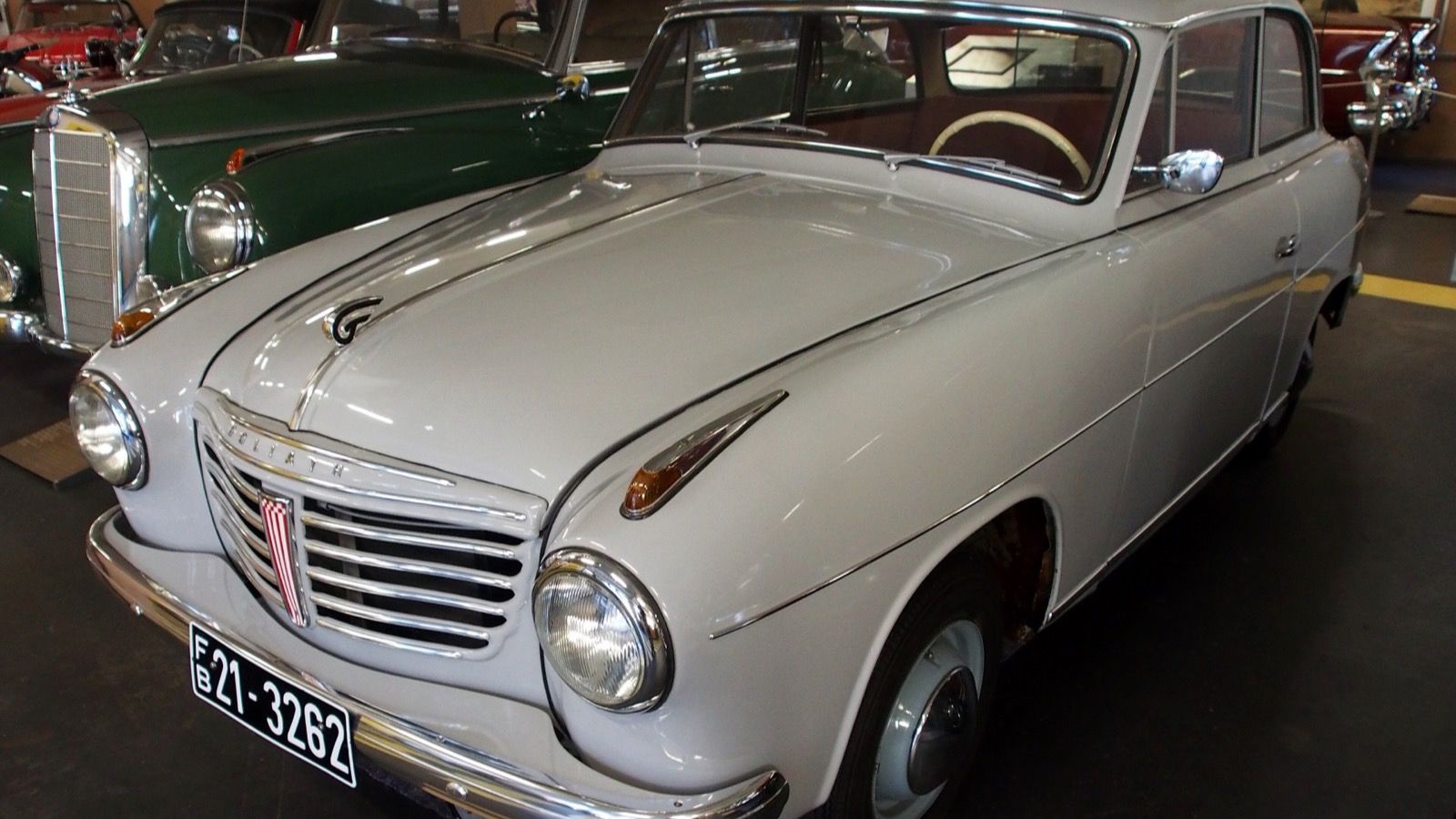
Goliath GP700 / GP900 History
Borgward's postwar bubble car and one of the world's first fuel-injected production cars — the GP700 Sport used Bosch injection in 1952.
Photo: “1956 Goliath GP 700 688cc 25hp 108kmh pic2” by Alf van Beem / Wikimedia Commons — CC0 1.0. Cropped to 16:9.
History
Launched in 1950 alongside the Lloyd LP300, the Goliath GP700 was Borgward's answer to Germany's postwar hunger for affordable, economical transport. Powered by a transversely mounted 688 cc two-cylinder two-stroke engine producing 25 bhp, it was a compact front-wheel-drive saloon with a claimed top speed of 102 km/h (63 mph). Its pontoon styling was considered modern for its era and was said to have influenced larger German rivals.
The landmark moment came in 1952: the GP700 Sport became one of the first production cars in the world to use Bosch direct fuel injection, a technology that would not appear on the celebrated Mercedes-Benz 300 SL until 1954. The injected Sport produced 32 bhp from an 845 cc engine and could reach 125 km/h (78 mph). Bosch injection subsequently became available on the standard GP700 saloon (designated GP700 E, 'E' for 'Einspritzung'), alongside the carburettor version.
In 1955 the range was expanded with the GP900 E, which bored the two-stroke unit out to 886 cc and raised output to a claimed 50 bhp — a 38 percent jump over the carburettor GP700 — giving a maximum of 120 km/h (75 mph). The GP700 and GP900 continued side by side until 1957, when both were replaced by the wholly different Goliath 1100.
Generations
GP700 · GP700 / GP700 E
Photo: “1956 Goliath GP 700 688cc 25hp 108kmh pic2” by Alf van Beem / Wikimedia Commons — CC0 1.0. Cropped to 16:9.
688 cc two-stroke two-cylinder, available with carburettor or (from 1952) Bosch fuel injection; one of the first injected production cars in the world.
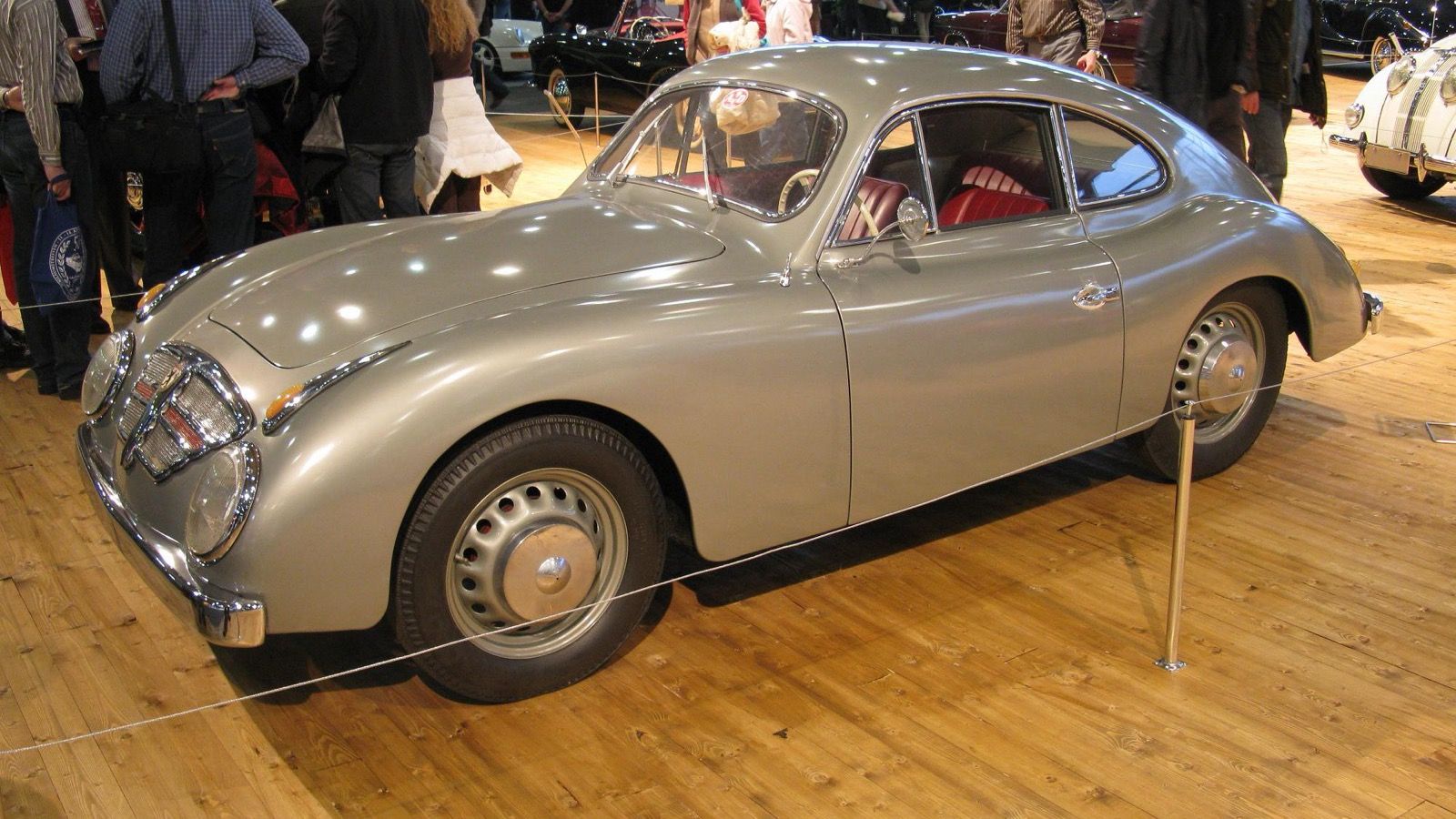
1952 Photo: “Goliath GP 700 Sport Coupé 1952 (5429141199)” by nakhon100 / Wikimedia Commons, licensed under CC BY 2.0. Cropped to 16:9.
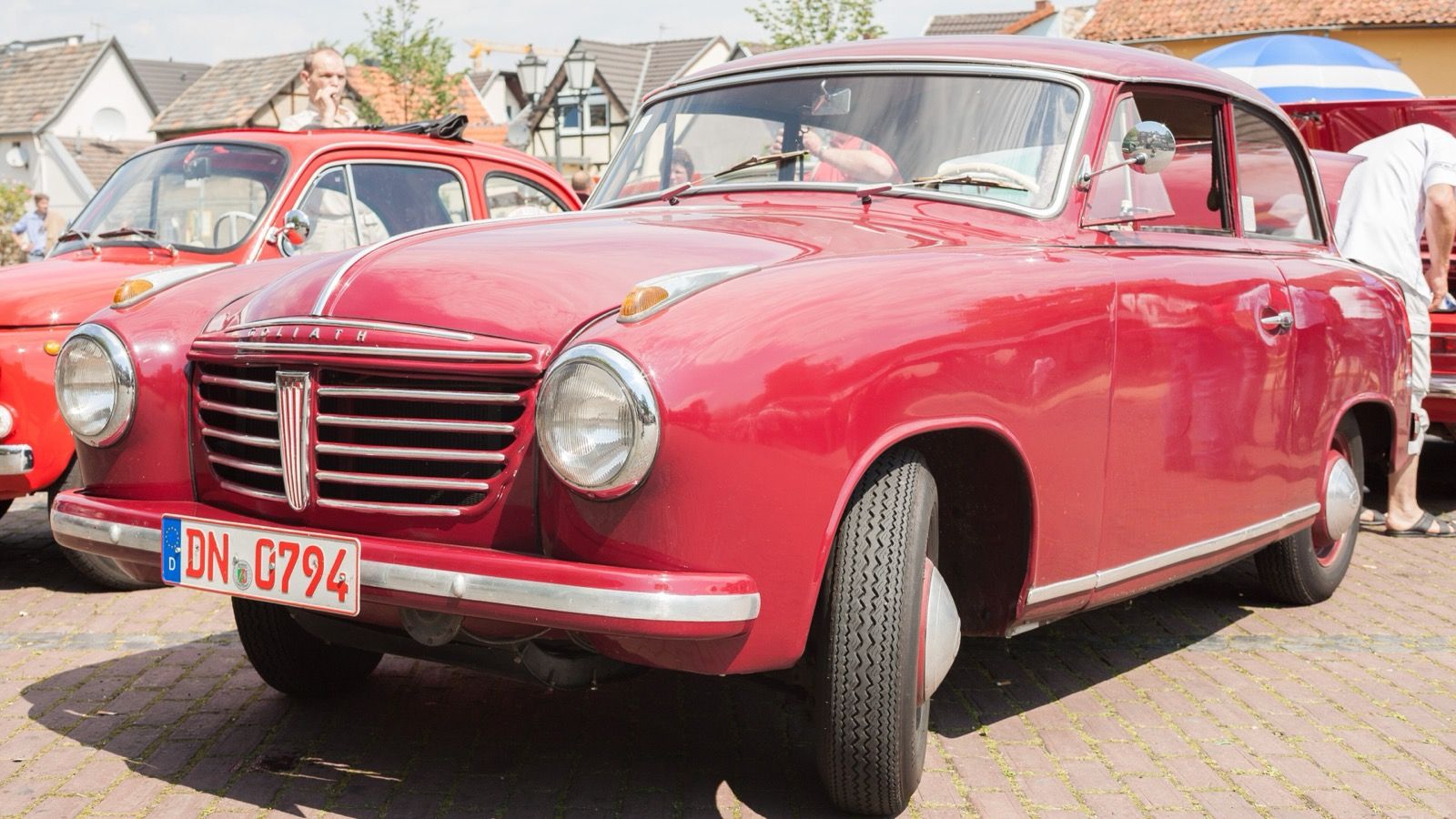
1955 Photo: “2007-07-15 Goliath GP700, Baujahr 1955 IMG 2998” by Eckhard Henkel / Wikimedia Commons, licensed under CC BY-SA 3.0 de. Cropped to 16:9.
GP900 · GP900 E
886 cc bored-out variant available only with Bosch injection; 50 bhp and 120 km/h, produced alongside the GP700 until 1957.
Body styles
- Saloon
- Cabriolet
- Estate
- Sport Coupé
- Panel Van
Notable special editions & performance variants
GP700 Sport
Limited-production sport coupé with an 845 cc two-stroke and Bosch direct fuel injection — historically significant as one of the world's first fuel-injected production cars.
Related models
Collect the nameplate
Find a scale model of the Goliath GP700 / GP900
Search Amazon across available years, colors, and scales. Exact releases vary, so confirm the listing before ordering.